Amendment of the Constitution
1. Introduction & Basic Facts
Part XX, article 368 of the Constitution deals with the Amendment of the Constitution. A "Bare Act" represents the law as it is, without any simplification, explanatory footnoting, or interpretation. Clauses are denoted as (368(a), 368(1)), and capital letters (e.g., 368A) generally signify an Article added by an amendment.
Fundamental Rules of Amendment:
- The power of amending resides with the Union (Parliament) ONLY.
- State Legislatures cannot initiate amendments (they only have a limited role in ratifying when the federal structure is involved).
- Both Houses (Lok Sabha & Rajya Sabha) can introduce amendment bills.
- Can be introduced by Ministers or Private Members (non-ministers, from ruling or opposition parties).
- No prior permission from the President is required to introduce a Constitutional Amendment Bill under Article 368.
Note: Any variation, addition, or repeal—even adding a comma or deleting a dot—constitutes an amendment.
2. Journey of a Constitutional Amendment Bill
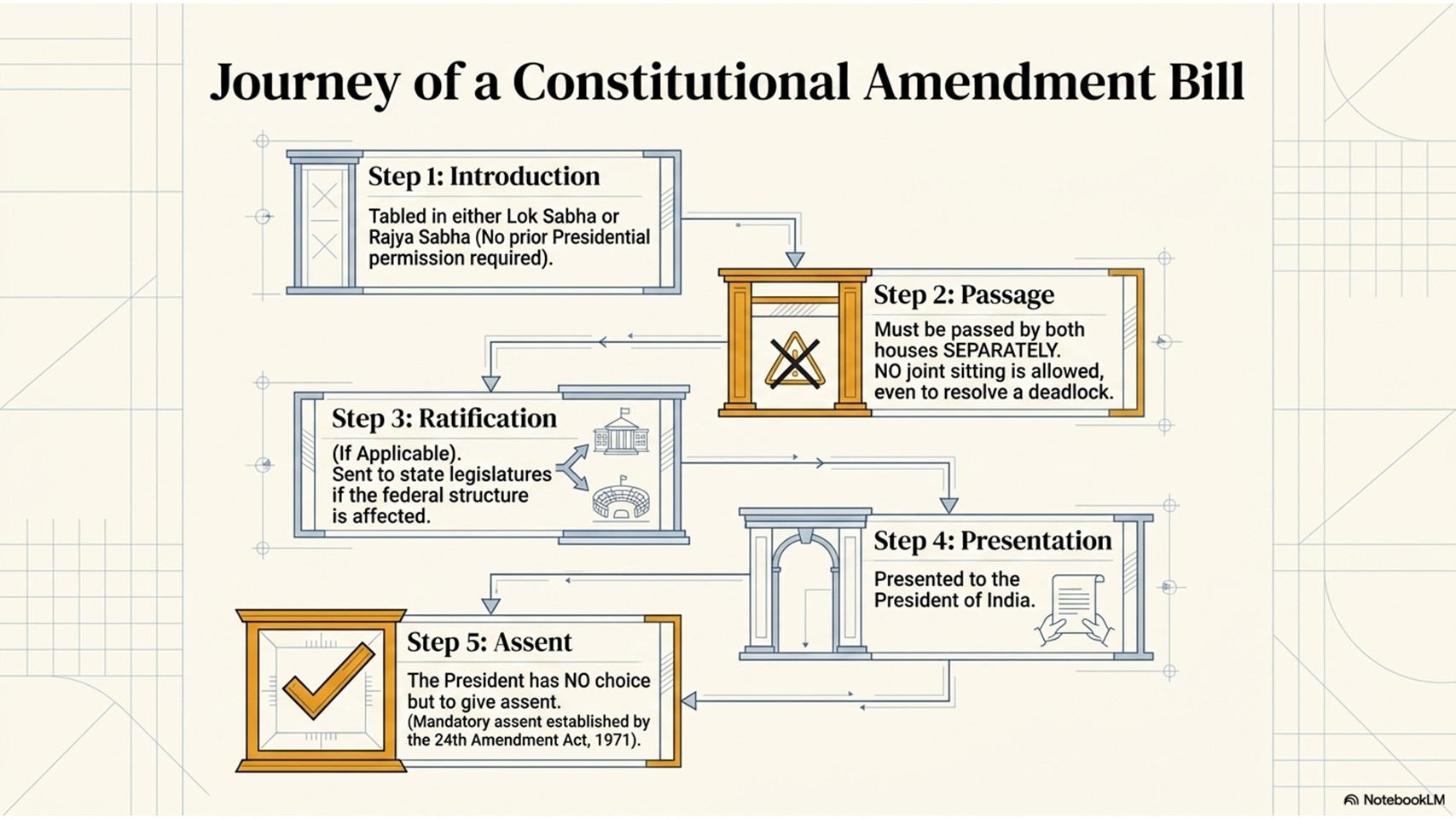
The procedure for passing an amendment is strictly defined. An amendment to the constitution does not necessarily have to be done under Article 368; minor amendments can be done outside its scope (e.g., Article 3 and 4, Reorganization of States).
- The bill is tabled on the floor by MPs in either the Lok Sabha or Rajya Sabha.
- The bill has to be passed by both houses SEPARATELY.
- There is NO JOINT SITTING of houses, even in the case of a deadlock.
- Once passed by both houses, it is presented to the President.
- The President has NO choice but to assent ("YES") to the bill (Corrected fact: Established by the 24th Amendment Act, 1971, amending Article 368(2)).
3. Nature and Types of Amendments
There are two primary methods to amend or change the interpretation of the Constitution: Informal and Formal.
Informal Methods
- New Conventions: When new practices are established (e.g., the judiciary ruling that walking on footpaths forms part of Article 21 - Right to Life & Liberty).
- Judicial Interpretation: When the Supreme Court (the ultimate interpreter) changes its stance. Article 137 enables the SC to review its own decisions, and Article 141 makes its judgments binding on all courts in India.
Formal Methods are categorized into Flexible and Rigid approaches:
- Flexible: Procedures that are of a temporary nature and can be easily altered. (e.g., 104th Amendment Act extended political reservations for another 10 years).
- Rigid: Provisions central to the Constitution's core philosophy. The Constituent Assembly made these rigid to preserve the spirit of the document, primarily governed by Article 368.
4. Categorisation of Formal Amendments
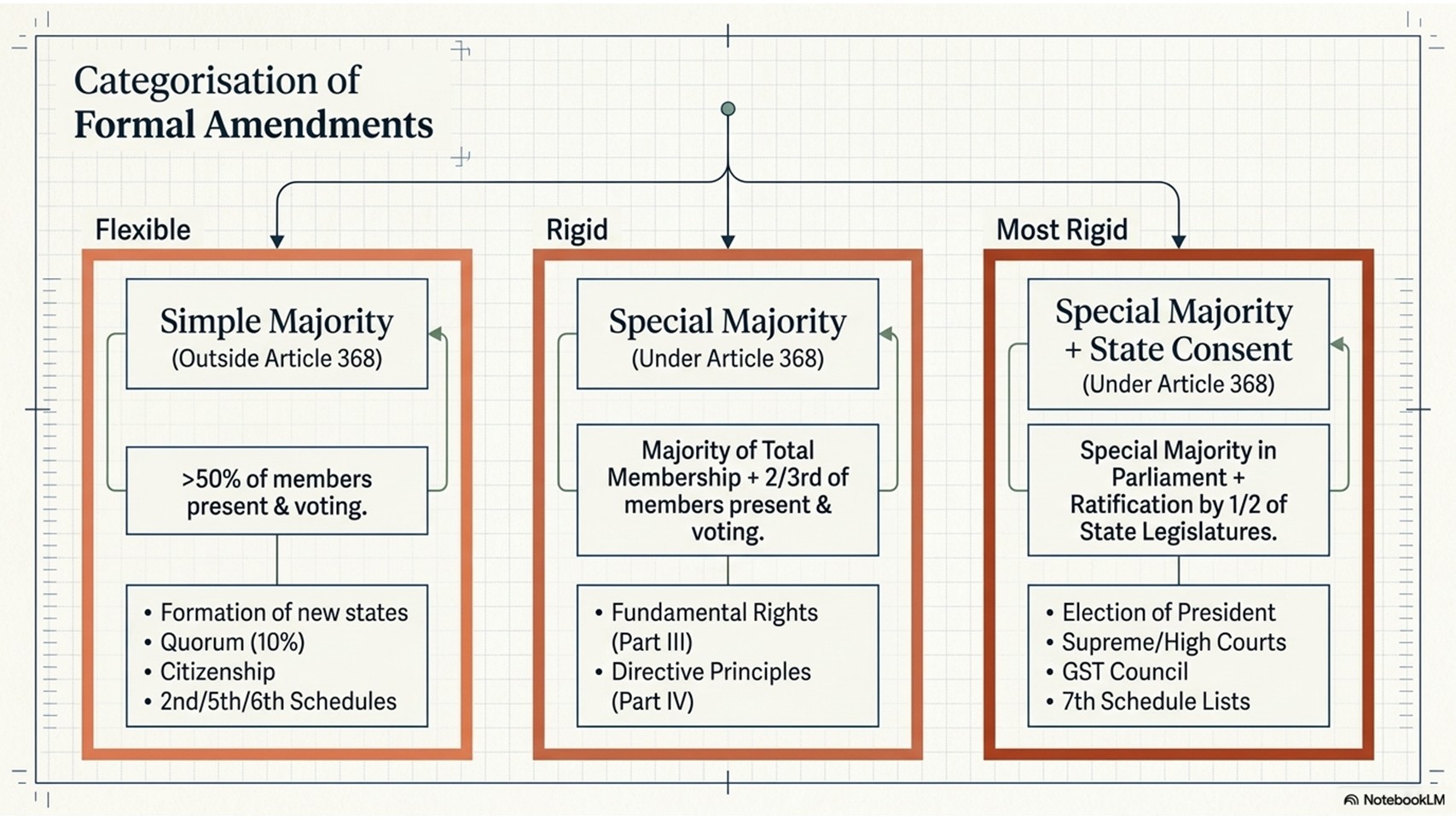
| Simple Majority (Outside Article 368) | Special Majority (Article 368) | Special Majority + State Consent (Article 368) |
|---|---|---|
| Majority of the members present & voting ( > 50%). Similar to the ordinary legislative process. | Majority of Total Membership of the House PLUS a majority of 2/3rd of members present & voting. | Special Majority in Parliament PLUS ratification by simple majority of at least 1/2 of the State Legislatures. |
| Used for less critical, structural changes like state reorganization or procedural rules. | Used for highly important constitutional aspects like Fundamental Rights. | Used exclusively for provisions affecting the Federal Structure of the country. |
1. Simple Majority (Outside Scope of Article 368)
- Admission, establishment, or formation of new states, and alteration of areas/boundaries/names.
- Abolition or creation of State Legislative Councils (Article 169).
- 2nd Schedule: Emoluments, allowances, and privileges of the President, Governors, Speakers, Judges, etc.
- Quorum in Parliament (Minimum 10% needed to start a session).
- Salaries and allowances of MPs, Rules of Procedure, Privileges of Parliament/Members/Committees.
- Use of English/Official languages in Parliament.
- Citizenship: Acquisition and termination.
- Elections to Parliament and State Legislatures, delimitation of constituencies.
- Number of Puisne Judges in the SC and modifying the jurisdiction of the Supreme Court.
- Union Territories, 5th Schedule, and 6th Schedule administration.
2. Special Majority (Under Article 368)
This includes provisions regarding Fundamental Rights (Part III), Directive Principles of State Policy (Part IV), and all other provisions not covered by the Simple Majority or Federal categories.
3. Special Majority + Consent of States (Under Article 368)
- Election of the President and its manner.
- Extent of executive power of the Union and the States.
- Supreme Court and High Courts.
- Distribution of legislative powers between Union and States.
- Any of the lists in the 7th Schedule.
- Representation of States in Parliament.
- GST Council.
- The power of Parliament to amend the Constitution and its procedure (Article 368 itself).
5. Nature of the Amendment Process
The Indian Constitution utilizes both formal and informal methods to adapt to changing times.
- Informal Methods: Changes occur without altering the written text. This happens through the establishment of new conventions or when the Judiciary changes its interpretation of a law. The Supreme Court is the ultimate interpreter, utilizing its power of judicial review (Article 137) to review its own decisions, making its judgments binding on all courts in India (Article 141). For example, expanding the interpretation of Article 21 (Right to Life and Liberty) to include livelihood/shelter on footpaths.
- Formal Methods: Direct alteration of the text, balancing Flexibility and Rigidity. Some temporary provisions are flexible (e.g., the 104th Amendment extending SC/ST reservations for 10 years), while core features preserving the Constitution's spirit remain rigidly protected via Article 368.
6. Analytical View on Amendments
Q Why are there so many amendments to the Indian Constitution? (106 Amendments in 77 years)
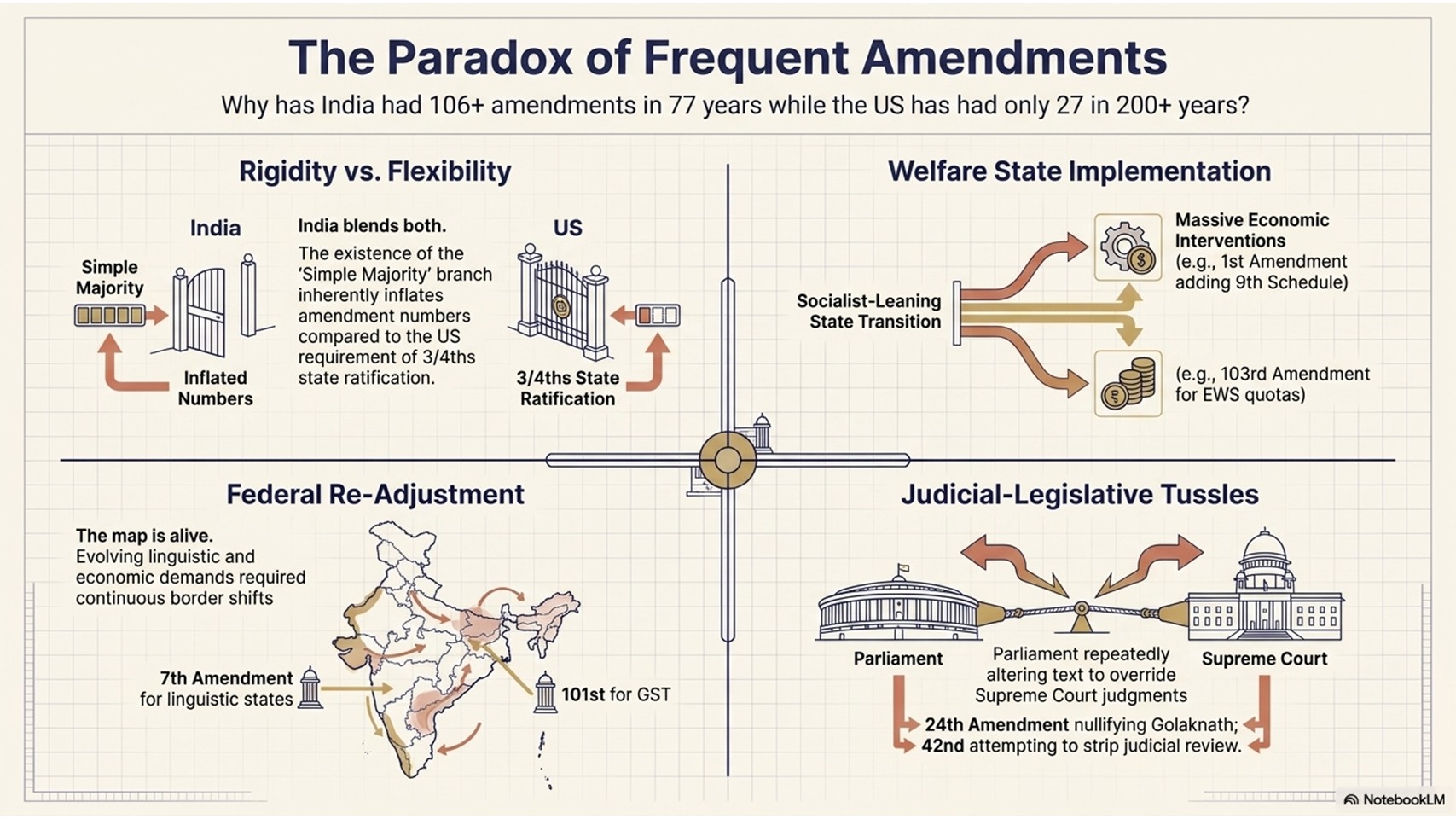
India has passed over 106 amendments in less than 80 years, contrasting sharply with the US Constitution, which has seen only 27 amendments in over 200 years due to its extreme rigidity (requiring 3/4ths state ratification). The primary drivers for India's frequent amendments are:
1. Rigidity vs. Flexibility: India blends both. A purely rigid constitution like
the USA has only seen 27 amendments in over 200 years because it requires 3/4th state ratification.
India's simple majority option inflates the number.
2. Implementation of a Welfare State: Transitioning to a socialist-leaning welfare
state required economic intervention via constitutional amendments (e.g., 1st Amendment adding the
9th Schedule, 103rd Amendment for EWS quotas). Capitalist countries like the USA do not require
these interventions.
3. Federal Re-Adjustment: India's political map has constantly evolved since 1947
to accommodate linguistic and economic demands. (e.g., 7th Amendment Act for states on linguistic
lines, 36th Amendment integrating Sikkim, 101st Amendment for GST).
4. Judicial-Legislative Tussles: Parliament frequently enacted amendments to
nullify Supreme Court judgments. (e.g., the 24th Amendment Act to nullify the Golaknath case; the
42nd Amendment Act attempted to strip the Judiciary of its review power).
Q Is Constitutional Amendment Necessary?
YES. Amendments are critical to:
- Make the Constitution relevant to changing realities and contemporary conditions.
- Align with the changing needs and aspirations of society.
- Ensure synchronization between the constitutional setup and evolving government policies.
- Meet unforeseen exigencies, such as economic or political emergencies.
- Ensure Social Justice as enshrined in the Preamble (e.g., the 42nd Amendment added "Socialist", "Secular", and "Integrity", strengthening Directive Principles).
Q What are the challenges related to frequent amendments?
- Erosion of Credibility: Frequent changes reduce public trust and stability, making the constitution appear subject to temporary political interests (e.g., the 42nd Amendment made extensive partisan changes).
- Institutional Instability: Constant amendments change the function and power of constitutional institutions, creating uncertainty.
- Conflicts Among Constitutional Organs: Altering powers can lead to friction between the Legislature, Executive, and Judiciary (e.g., the 42nd Act limited judicial review, sparking conflict).
- Fragmentation of Constitutional Philosophy: Excessive amendments may weaken original ideals and threaten the Basic Structure. (e.g., Corrected Fact: The 39th Amendment Act, 1975 attempted to place the PM's election beyond judicial review. It was challenged in the Indira Nehru Gandhi vs. Raj Narain case because it threatened the basic structure).
- Strained Relations: Causes tension between the Judiciary and Executive, affecting judicial independence (e.g., the 99th Constitutional Amendment Act, 2014, establishing the NJAC, was struck down by the SC).
7. Types of Majorities in Indian Parliament
| Type of Majority | Definition & Formula | Where Used / Scope |
|---|---|---|
| Simple Majority | More than 50% of members present and voting (excluding abstentions/vacancies). | Passing Ordinary Bills, Money Bills, No-Confidence Motion, Vote of Confidence, Confidence Motion, Censure Motion, Adjournment Motion, Election of Speaker/Deputy Speaker of LS & SLA, Ratification of CAAs affecting federalism by States. |
| Absolute Majority | More than 50% of the Total Membership of the House (e.g. 273+ out of 543 in Lok Sabha). | Forming government after elections (stability benchmark); not used alone for passing any bill. |
| Effective Majority | More than 50% of the Effective Strength (Total Membership minus Vacancies). | Removal of Vice-President in Rajya Sabha (Art 67(b)), Removal of Speaker/Deputy Speaker of LS & State Assemblies, Removal of Deputy Chairman of RS. |
| Special Majority (Art 368) | (i) $\ge 50\%$ of Total Strength AND (ii) $\ge 2/3\text{rd}$ of members Present & Voting. | Constitutional Amendment Bills under Art 368, Removal of SC/HC Judges (Judges Inquiry Act), Removal of CAG, CVC, CEC. |
| Special Majority (Art 61) | $\ge 2/3\text{rd}$ of the Total Membership of each House. | Used exclusively for the Impeachment of the President of India. |
| Special Majority (Art 249 / 312) | $\ge 2/3\text{rd}$ of members Present & Voting in Rajya Sabha. | State List legislation by Parliament (Art 249), Creation of All-India Services (Art 312). |
8. Evolution of Basic Structure Doctrine (Landmark Case Timeline)
| Landmark Case & Year | Core Constitutional Question | Supreme Court Ruling & Significance |
|---|---|---|
| Shankari Prasad v. Union of India (1951) | Can Parliament amend Fundamental Rights under Article 368? (Challenging 1st CAA 1951). | SC ruled that Article 368 power includes power to amend Part III (FRs). "Law" in Art 13(2) covers only ordinary laws, not Constitutional Amendments. |
| Sajjan Singh v. State of Rajasthan (1965) | Challenged the 17th CAA 1964. | SC upheld Shankari Prasad ratio; Parliament can amend any part of the Constitution, including FRs. (Justice Mudholkar dissented, coining "Basic Features"). |
| Golak Nath v. State of Punjab (1967) | Can Parliament dilute or take away Fundamental Rights? (11-Judge Bench). | SC reversed earlier rulings. Held that FRs are transcendental and sacrosanct. An amendment under Art 368 is a "law" under Art 13, so Parliament CANNOT abridge FRs. |
| 24th & 25th CAA (1971) | Parliament's counter-legislative action to nullify Golak Nath judgment. | Inserted Art 13(4) & Art 368(3) clarifying that Art 13 does NOT apply to Art 368 amendments; gave Parliament power to amend any provision of Part III. |
| Kesavananda Bharati v. State of Kerala (1973) | Validity of 24th CAA & scope of Art 368 (13-Judge Bench — largest ever). | Overruled Golak Nath. Held Parliament CAN amend any part of the Constitution including Part III, BUT CANNOT alter or destroy the "Basic Structure" of the Constitution. |
| Indira Nehru Gandhi v. Raj Narain (1975) | Validity of 39th CAA 1975 (placing election of PM & Speaker beyond judicial review). | SC struck down clause 4 of 39th CAA. Confirmed that Judicial Review and Free & Fair Elections are part of the Basic Structure. |
| Minerva Mills v. Union of India (1980) | Challenged 42nd CAA 1976 (which gave unlimited amendment power to Parliament & subordinated FRs to all DPSPs). | SC struck down clauses (4) & (5) of Art 368. Held that Judicial Review and the Harmony/Balance between FRs and DPSPs are part of the Basic Structure. |
| I.R. Coelho v. State of Tamil Nadu (2007) | Is the Ninth Schedule immune from judicial review post-1973? (9-Judge Bench). | SC held that laws placed in Ninth Schedule after April 24, 1973 (Kesavananda verdict date) are subject to Judicial Review against the Basic Structure test. |
9. Concept Spotlight: Federalism
What is Federalism?
Local self-government is best explained as decentralization. Federalism is derived from the Latin word 'Foedus', which means an agreement.
- It is a form of government in which sovereign authority and political power are constitutionally divided between the Center and the States.
- Each entity is independent in controlling its own respective spheres.
- A federation combines National and Local governments under a common sovereignty, with powers strictly assigned to them by the Constitution.
Note: Global Comparison - Australia follows a similar amendment procedure to India but also requires a public referendum.