INDIAN CONSTITUTION
Part I: The Union and Its Territory
Q What are Articles?
Articles are the individual legal provisions or rules that explain how the Constitution works. For example, just as a book has chapters and a chapter has sections, the Constitution is divided into Parts, and each Part contains Articles.
Article 1: Identity of India
As per our Constitution, "India, that is Bharat, shall be a Union of States."
Q Why was the phrase "Union of States" preferred by the Constitution Makers over "Federation of States"?
According to Dr. B.R. Ambedkar, there are two primary reasons for this preference:
- The Indian federation is not the result of an agreement among the states, unlike the American Federation.
- The states have no right to secede from the federation because it is an indestructible union.
India is an integral whole, divided into different states ONLY for the convenience of administration.
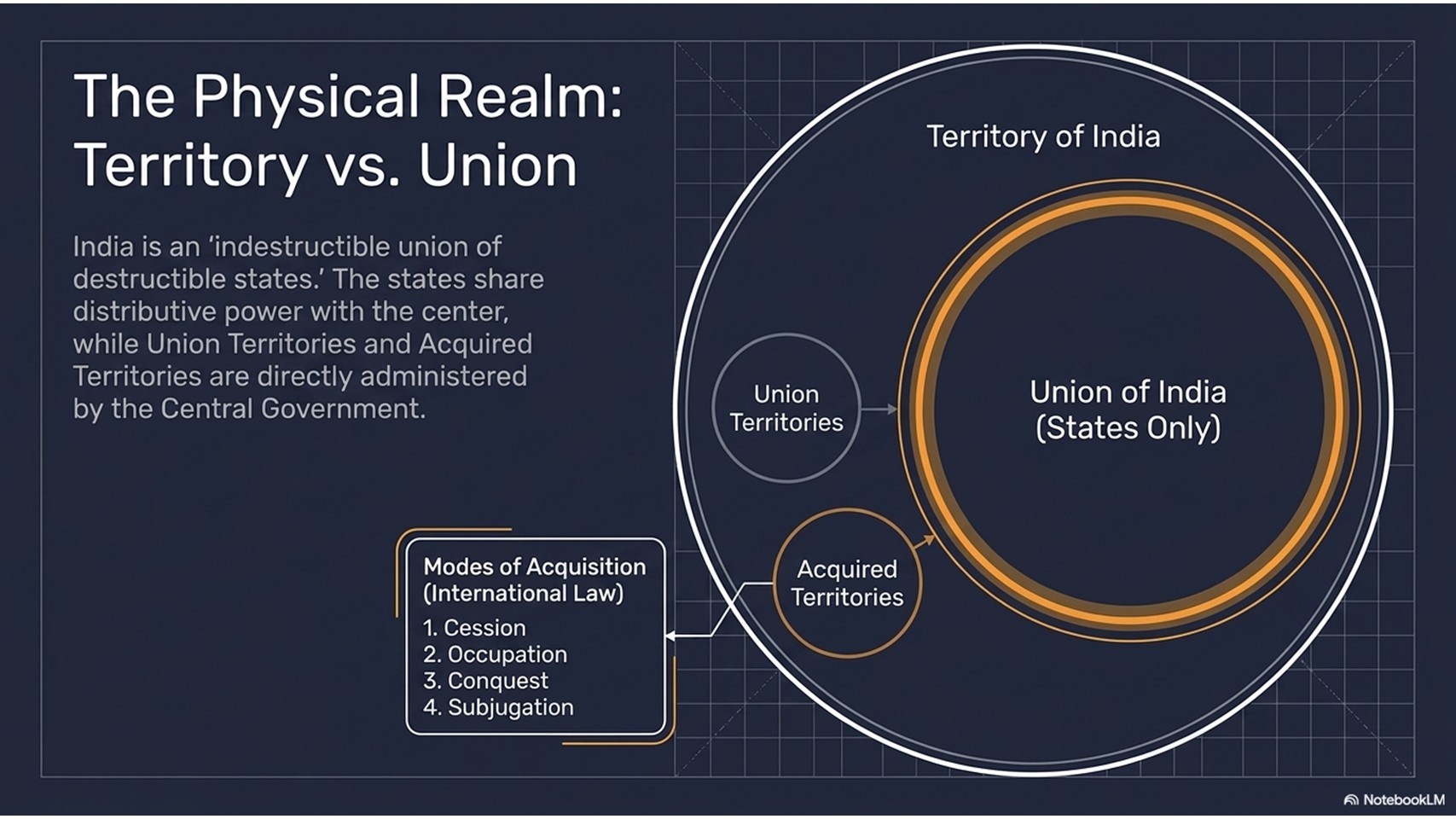
| Territory of India | Union of India |
|---|---|
| A wider concept that includes states, Union Territories (UTs), and any territories that may be acquired by the Government of India in the future. | A narrower expression as it includes ONLY the states. |
| UTs and acquired territories are directly administered by the Central Government. | States are members of the federal system and share distributive power with the Centre. |
What are Acquired Territories?
Being a sovereign state, India can acquire foreign territories according to modes recognized by International Law. The four modes are:
- Cession (by treaty, purchase, or plebiscite)
- Occupation (unoccupied by any other state)
- Conquest
- Subjugation
According to the Supreme Court, acquiring territory is an inherent attribute of a sovereign state under international law; the mere usage of the word "acquire" in the Constitution doesn't confer this right, but rather acknowledges it.
• If ceding (giving away) territory → Requires a constitutional amendment under Article 368 (e.g., Berubari Union Case, 100th CAA).
• If annexing (acquiring) territory → No constitutional amendment is needed; executive action suffices.
Article 2: Admission of New States
Article 2 relates to the admission or establishment of new states that are NOT currently part of the Union of India. It empowers the Parliament to act on terms and conditions as it thinks fit.
Accords two powers to the Parliament:
- Power 1: To admit new states into the Union of India.
- Power 2: To establish new states that were not in existence before.
Example: The addition of Sikkim into India (via 35th and 36th Amendment Acts).
Article 3: Domestic Reorganization
Article 3 deals with changes to existing states, which can be done only by Parliament through the enactment of law.
Parliament is authorized to:
- Increase or diminish the area of any state.
- Alter the boundaries or the name of any state.
- Form a new state by separating territory from any state, uniting two or more states (or parts of states), or uniting any territory to a part of a state.
18th Constitutional Amendment Act (1966): Amended Article 3 to include 'Union Territories' within the definition of 'State', empowering Parliament to form a new State or UT by uniting a part of any State or UT to any other State or UT.
(Example: Ladakh was formed as a UT with a simple majority in Parliament under Article 3, after the J&K Reorganisation Act, 2019).
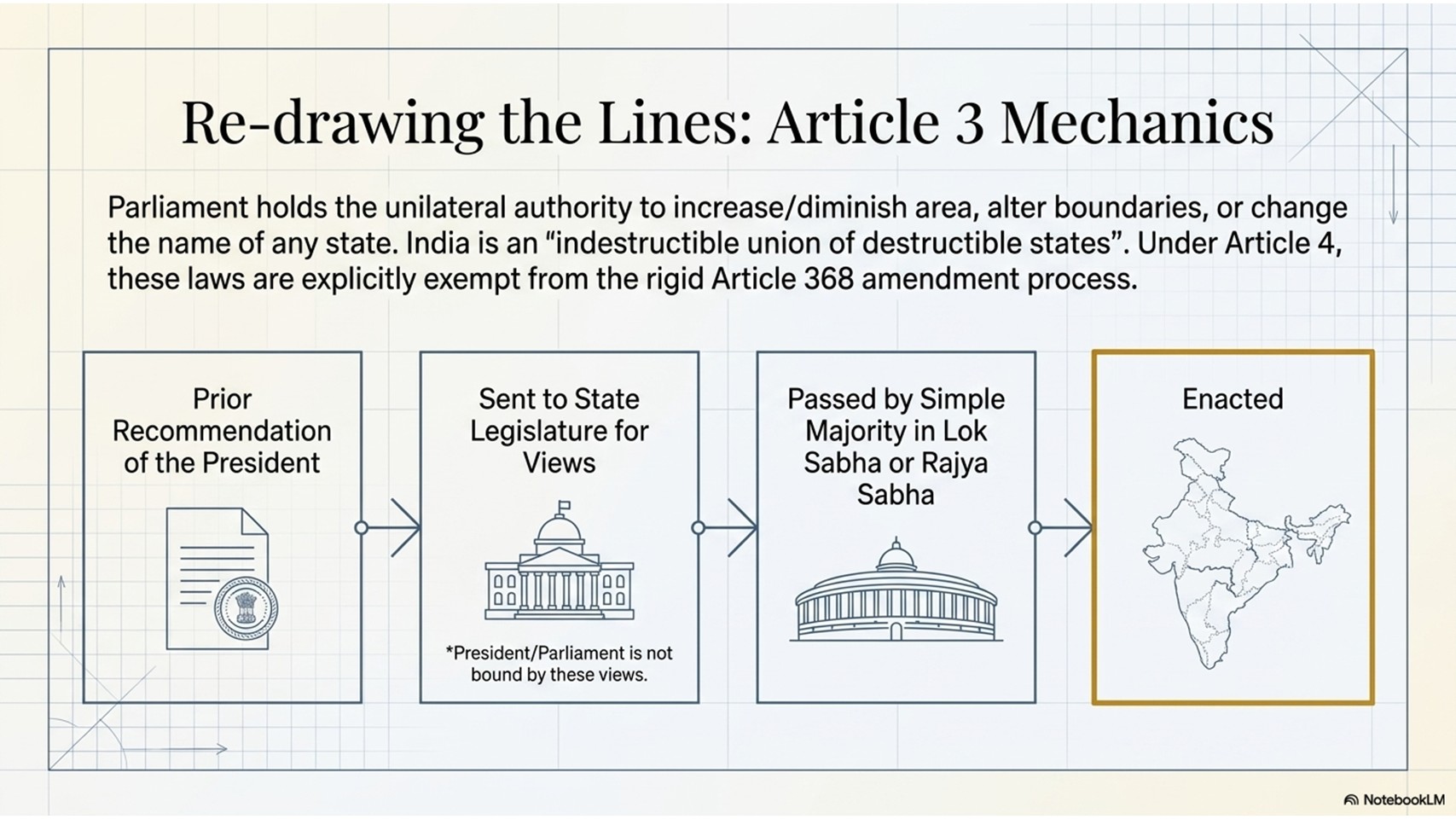
Bill Implementation Process for Article 3:
- Requires prior recommendation by the President.
- Prior to introduction, the President sends the bill to the concerned State Legislature for their views. (For UTs, this step is eliminated).
- Can be passed by either the Lok Sabha (LS) or Rajya Sabha (RS) with a Simple Majority.
Article 4: Exemption from Article 368
Article 4 declares that laws made for the admission/establishment of new states (Article 2) and the formation/alteration of existing states (Article 3) are NOT to be considered as an amendment of the Constitution under Article 368.
This means that such laws can be passed by a simple majority via the ordinary legislative process. It will be considered as an amendment to the Constitution, but NOT under Article 368.
Comparative Analysis: India vs USA
| India | USA |
|---|---|
| An indestructible union of destructible states. | An indestructible union of indestructible states. |
| Territorial integrity of states is NOT guaranteed. | Territorial integrity of states is guaranteed. |
| When the President refers the bill to the State Legislature, the President/Parliament is not bound by the State Legislature's views and may accept or reject them, even if received on time. | The American federal government cannot form new states or alter boundaries without the explicit consent of the State concerned. |
Summary of Articles 1 to 4
- Article 1: Identity of India (India = Bharat; Union of States). Defines territories of India (States, UTs, and future acquired territories).
- Article 2: New states enter India (admission or establishment of states from outside).
- Article 3: Changes to existing states (names, area, boundaries, formation).
- Article 4: Implements Articles 2 and 3 without using the Article 368 amendment procedure.