POLITICAL SCIENCE
1. Local Self-Government & Federalism
Q What is Federalism?
The term Federalism is derived from the Latin word 'Foedus', which means an agreement. It is a form of government in which the sovereign authority of political power is constitutionally divided between the center and the states. Each sphere of government is independent in its own domain.
- A federation is an agreement between two types of government sharing power and spheres of control.
- Under a federal system, the national and state/local governments combined exercise the sovereignty assigned to them by the Constitution.
2. Delegation, Devolution & Decentralization
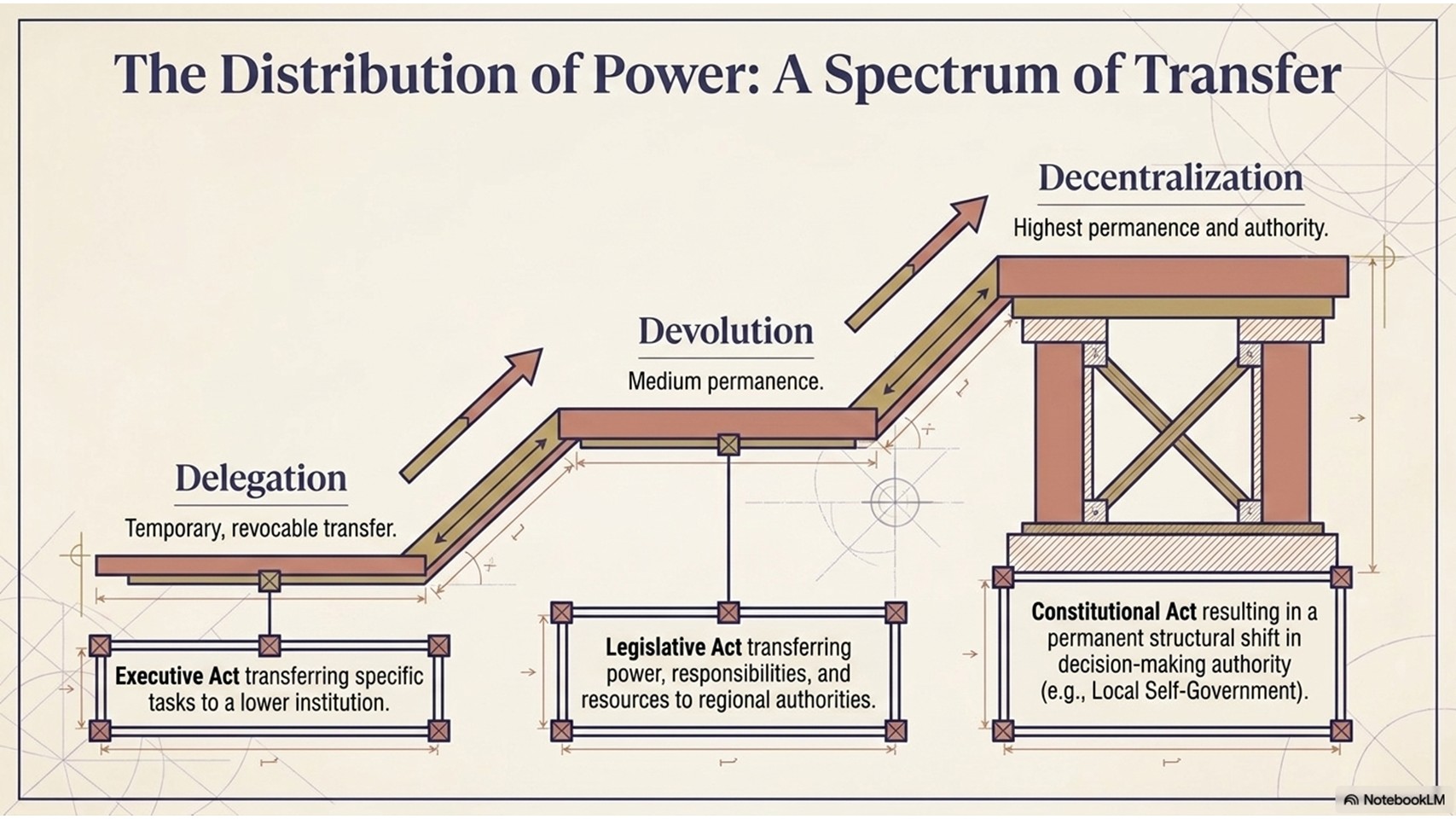
To understand federalism, you must distinguish it from other forms of power distribution. Conceptual clarity here is non-negotiable.
| Delegation | Devolution | Decentralization |
|---|---|---|
| Transfer of specific powers or responsibilities from a higher authority (e.g., legislature, executive, or central government) to a lower institution or individual to perform on its behalf. | Transfer of power, responsibilities, and resources from a central government to a lower level of government, such as regional or state authorities. | The process of distributing decision-making authority and resources from a central authority to a lower level of government or organization. |
| Typically a temporary, revocable transfer done by an Executive Act. | Typically involves a more permanent transfer of power by a Legislative Act. | Usually a permanent structural shift mandated by a Constitutional Act. |
3. Types of Federalism
1. Holding Together Federation
- A larger entity decides to share its powers between various constituent parts to accommodate diversity.
- Power is generally tilted towards the central authority.
- Examples: India, Spain, Belgium.
2. Coming Together Federation
- Independent states come together to form a larger unit.
- States generally enjoy more autonomy compared to the "holding together" model.
- Examples: USA, Australia, Switzerland.
3. Asymmetrical Federation
- Some constituent units have more power or special status than others due to historical or cultural reasons.
- Examples: Canada (Quebec), Russia (Chechnya), Ethiopia (Tigray).
4. Essential Features of Federalism
Before studying Indian Federalism, focus on the universal core tenets of a federal structure:
- Dual Polity: The center usually deals with matters of national importance, whereas states are entrusted with local matters.
- Supremacy of the Constitution: Powers originate from the Constitution, ensuring no authority takes arbitrary action over the other. This necessitates a Written Constitution.
- Rigidity of the Constitution: Makes unilateral amendment complicated and tough, ensuring any change in the structure stems from both authorities (Center & State).
- Authority of Courts: Since federalism is based on the division of power between coordinate governments, an independent and impartial judiciary is essential to maintain coordination and ensure neither transgresses into the other's domain. The Judiciary acts as the final arbiter to interpret the Constitution.
5. Unitary vs. Federal Features
| Unitary Government | Federal Government |
|---|---|
| Single government; all power lies with the national government. | Dual government; division of power between national and regional governments. |
| Constitution may be written (France) or unwritten (UK). | Constitution must be written. |
| Constitution may be supreme (Japan) or may not be supreme (UK). | Supremacy of the Constitution is mandatory. |
| Constitution may be rigid (France) or flexible (UK). | Constitution must be rigid. |
| Judiciary may or may not be independent. | Independent Judiciary is mandatory. |
| Legislature may be bicameral (UK) or unicameral (China). | Legislature is usually bicameral (two houses). |
Q What is Indian Federalism?
According to Dr. B.R. Ambedkar, the Indian Constitution avoids the tight mold of federalism and could be both unitary as well as federal according to the requirements of time and circumstances. Therefore, Indian federalism is considered Sui-Generis (meaning "in a class by itself" or something unique).
6. Terms Attributed to Indian Federalism
Quasi-Federal (K.C. Wheare)
Introduced by K.C. Wheare in his work 'Federal Government'. According to him, the Indian Constitution establishes a system that is federal in form, but unitary in spirit. It focuses on a strong central authority, but states also enjoy autonomy in certain spheres. The balance of power is tilted towards the Central Government.
Co-operative Federalism
Refers to collaboration and partnership between Union and State governments to achieve common national goals. It focuses on interdependence between the center and states despite having defined areas in the Constitution. Examples: Article 263 (Inter-State Council), GST Council.
Bargaining Federalism
A dynamic process where different levels of government negotiate and bargain to address their respective interests. It shows a deterioration of cooperative federalism and a lack of trust. Example: Southern states (like Kerala, Tamil Nadu) demanding a greater share of financial resources, arguing they contribute more to the National GDP.
Competitive Federalism
A model where states compete with each other (and sometimes with the central government) to attract investment, improve governance, and deliver better services to citizens. Promotes healthy competition for faster economic growth, accountability, and responsiveness. Examples: Ease of Doing Business Index, Invest Punjab Summit.
7. Centralizing vs. Federal Features Matrix
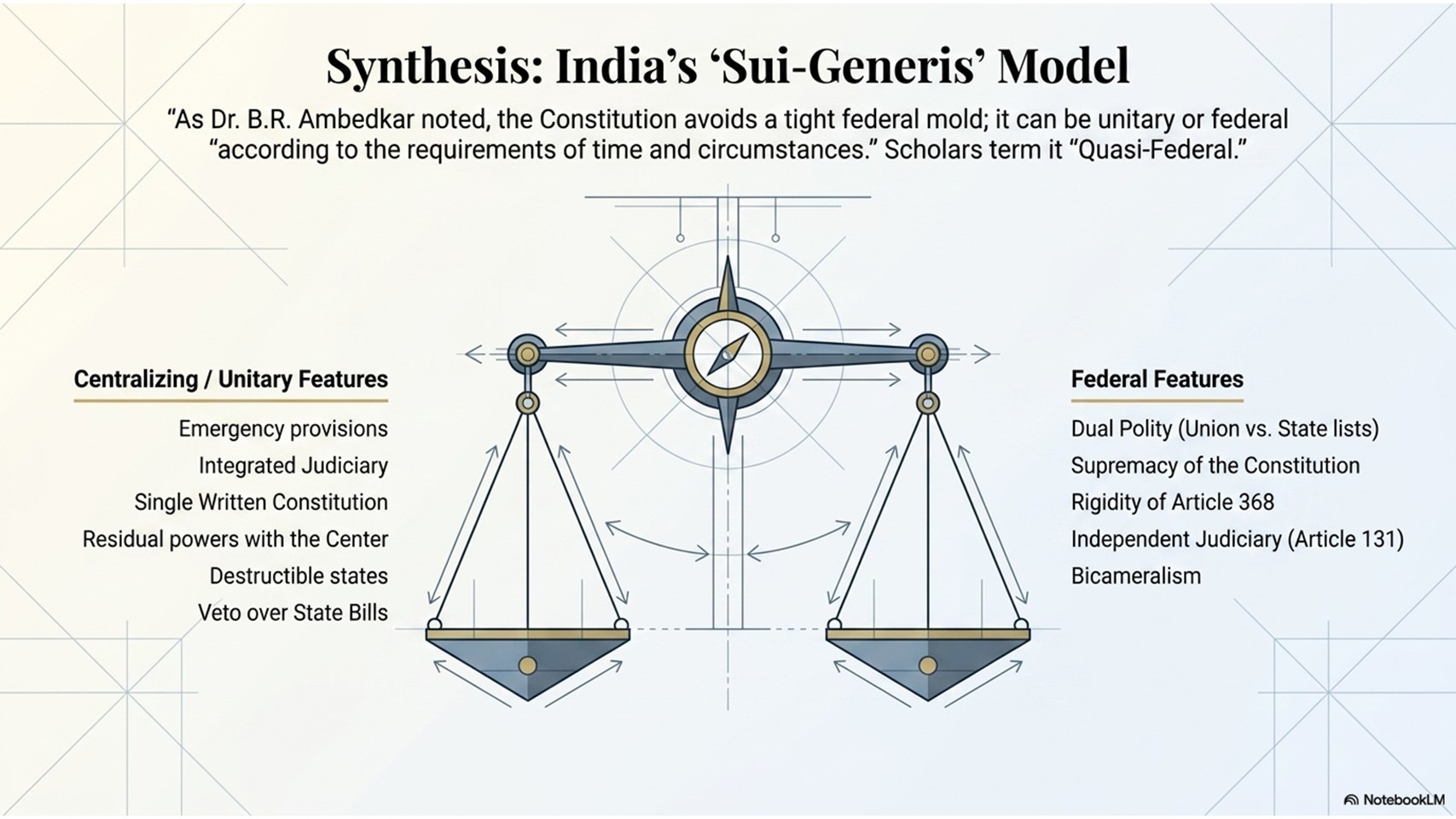
| Centralizing (Unitary) Features | Federal Features |
|---|---|
| Emergency provisions | Dual Polity (Article 1 & Article 246) |
| Integrated Judiciary | Supremacy of the Constitution |
| Concurrent List | Written Constitution |
| Residual powers lie with the Center | Rigidity of the Constitution (Article 368) |
| States are destructible | Independent Judiciary (Article 131) |
| Flexibility of the Constitution & Veto over State Bills | Division of Powers |
| Appointment of Governor & Parliamentary authority over State List | Bicameralism |
| Sharing of Revenue through Finance Commission |
Parliamentary Legislation in the State Field (5 Exceptional Circumstances)
Articles governing Parliament's power to legislate on State List matters (Part XI):
- Article 249 (National Interest): If Rajya Sabha passes a resolution supported by ≥ 2/3rd of members present and voting declaring that it is necessary in national interest. (Valid for 1 year at a time).
- Article 250 (During National Emergency): While a Proclamation of Emergency under Article 352 is in operation. (Law ceases to have effect 6 months after emergency ends).
- Article 252 (By Consent of 2 or More States): When Legislatures of 2 or more States pass resolutions requesting Parliament to enact laws on a State List subject. (Applies only to consenting states; other states can adopt later).
- Article 253 (Implementation of International Treaties): Parliament can make laws for whole/any part of India for implementing any international treaty, agreement, or convention without state consent.
- Article 356 (During President's Rule): When President's Rule is proclaimed in a State, Parliament assumes state legislative powers.
Commissions on Centre-State Relations:
- Administrative Reforms Commission (1966): Headed by Morarji Desai (later K. Hanumanthaiah). Recommended setting up of Inter-State Council under Article 263.
- Rajamannar Committee (1969): Appointed by Tamil Nadu Government (DMK). Recommended abolition of All-India Services and insertion of Article 263 council.
- Anandpur Sahib Resolution (1973): Demanded restricted central role to Defence, Foreign Affairs, Telegraphs, and Railways.
- West Bengal Memorandum (1977): Demanded replacement of word 'Union' with 'Federal' in the Constitution.
- Sarkaria Commission (1983): Headed by Justice R.S. Sarkaria (247 recommendations). Favored strong Centre to preserve unity; recommended permanent Inter-State Council under Art 263, consultation with CM before appointing Governor, and rare use of Article 356.
- Punchhi Commission (2007): Headed by Justice M.M. Punchhi. Recommended fixed 5-year tenure for Governors and localized emergency under Art 355/356.
Inter-State Water Disputes & Inter-State Council
- Inter-State Water Disputes (Article 262): Parliament may by law provide for adjudication of any dispute relating to use, distribution, or control of waters of any inter-state river or river valley. Parliament may exclude Supreme Court and other courts from jurisdiction over such disputes. (Inter-State River Water Disputes Act, 1956).
- Inter-State Council (Article 263): Established by President (set up in 1990 following Sarkaria Commission recommendation). Chaired by Prime Minister; includes CMs of all States & UTs with assemblies + 6 Cabinet Ministers.
Special Constitutional Provisions for Certain States (Articles 371 to 371-J)
| Article | State Concerned | Special Provisions / Development Boards | |
|---|---|---|---|
| Article 371 | Maharashtra & Gujarat | Separate development boards for Vidarbha, Marathwada (MH), and Saurashtra, Kutch (GJ). | |
| Article 371-A | Nagaland | Religious/social practices & customary law protected; Parliament Acts apply only if Assembly resolves. | |
| Article 371-B | Assam | Committee of State Assembly consisting of members elected from Tribal Areas. | |
| Article 371-C | Manipur | Committee of Legislative Assembly for Hill Areas. | |
| Article 371-D & 371-E | Andhra Pradesh & Telangana | Equitable opportunities in public employment & education; Central University in AP. | |
| Article 371-F | Sikkim | Special provisions following 36th CAA 1975 full statehood. | |
| Article 371-G | Mizoram | Mizo customary law and ownership of land protected. | |
| Article 371-H | Arunachal Pradesh | Special responsibility of Governor regarding law and order. |
| List | Original Count | Present Count | Exclusive Jurisdiction & Key Subjects |
|---|---|---|---|
| Union List (List I) | 97 items | 98 items | Exclusive Parliament jurisdiction: Defence, Atomic Energy, Foreign Affairs, Railways, Post & Telegraph, Banking, Currency, Citizenship, Inter-state trade. |
| State List (List II) | 66 items | 59 items | Exclusive State Legislature jurisdiction: Public Order, Police, Public Health & Sanitation, Agriculture, Prisons, Local Government, Markets & Fairs. (42nd CAA 1976 transferred 5 subjects to Concurrent List: Education, Forests, Weights & Measures, Protection of Wild Animals/Birds, Administration of Justice). |
| Concurrent List (List III) | 47 items | 52 items | Joint Jurisdiction (Union law prevails in case of conflict under Art 254): Criminal Law, Marriage & Divorce, Civil Procedure, Education, Forests, Electricity, Trade Unions. |
9. Property, Contracts, Rights & Liabilities of Government (Articles 294 to 300)
- Succession to Property & Assets (Articles 294 & 295): Assets and liabilities of East India Company / British Crown devolved upon the Union and States.
- Escheat, Lapse & Bona Vacantia (Article 296): Property in India that has no rightful owner (escheat/bona vacantia) vests in the State where located or Union.
- Government Contracts (Article 299): Executive power to make contracts. Contracts made by Union are expressed to be made by the President; contracts made by State by the Governor. President/Governor is personally immune from liability under contracts made in their official capacity.
- Suits and Proceedings (Article 300 - State Liability for Torts): Union of India and State Governments can sue and be sued in the name of Union of India / State.
• Sovereign vs. Non-Sovereign Functions: Historically, State enjoyed immunity for sovereign functions (military, police actions) under Kasturi Lal v. State of U.P. (1965).
• Modern Evolution: In Rudul Sah (1983) & Nilabati Behera (1993), SC established that State immunity cannot be claimed for violation of Fundamental Rights (Articles 21); State is vicariously liable for torts and illegal acts of its public servants.