Indian Polity
1. Presidential Veto Powers
The President has the power of:
- Pocket Veto: Can choose not to act on a bill (essentially keeping it in their pocket indefinitely).
- Suspensive Veto: Can return the bill for reconsideration of Parliament.
- Absolute Veto: Can withhold assent (saying "no" to the bill).
Note: If a bill is recommended by the President (such as a Money Bill), he/she generally cannot return it for reconsideration.
2. Reorganisation of States (Post-Independence 1947)
In independent India, the principal basis for the reorganisation of states was Language. British India did not follow this method; colonial state reorganisation was based simply on administrative convenience. What we see today is a result of much thought and debate between national leaders.
Historical Context:
- 1920 Nagpur Session: Congress accepted that language should be the basic basis for reorganisation. Gandhi ji organised the Pradesh Congress Committees (PCC) strictly on linguistic lines.
- Post-Independence Shift: After witnessing the horrors of partition, Jawaharlal Nehru opposed linguistic reorganisation. He feared that the numerous languages in India would lead to "Lilliputian States" (trivial or very small states).
- National vs. Linguistic Identity: Nehru focused on creating a National Identity over a Linguistic Identity. Leaders feared language could become a basis for raising regional demands (employment, subsidies) and create conflicts against people from other states.
Ultimately, a contrarian view prevailed: apart from language, what other basis (like religion or caste) could be used? It was agreed that language is a more secular basis for reorganisation than any other identity. After severe protests in South India, Andhra Pradesh was created in 1953 as the first linguistically organised state.
Holford State Classifications in 1950 (Part A, B, C, D)
After the integration of princely states, the Indian territory in 1950 was classified into a four-fold categorization:
| Category | Description | Examples |
|---|---|---|
| Part A | Erstwhile Governor's provinces (with elected legislature). | Assam, Bihar, Bombay, Madras, Punjab, UP, West Bengal, MP, Orissa (9 States). |
| Part B | Erstwhile Princely States with legislature. | Hyderabad, J&K, Madhya Bharat, Mysore, Rajasthan, Saurashtra (9 States). |
| Part C | Erstwhile Chief Commissioners' provinces + some princely states (centrally administered). | Ajmer, Bhopal, Coorg, Delhi, Himachal Pradesh, Manipur, Tripura (10 States). |
| Part D | Solely centrally administered territories. | Andaman and Nicobar Islands. |
2. State Reorganisation Commissions
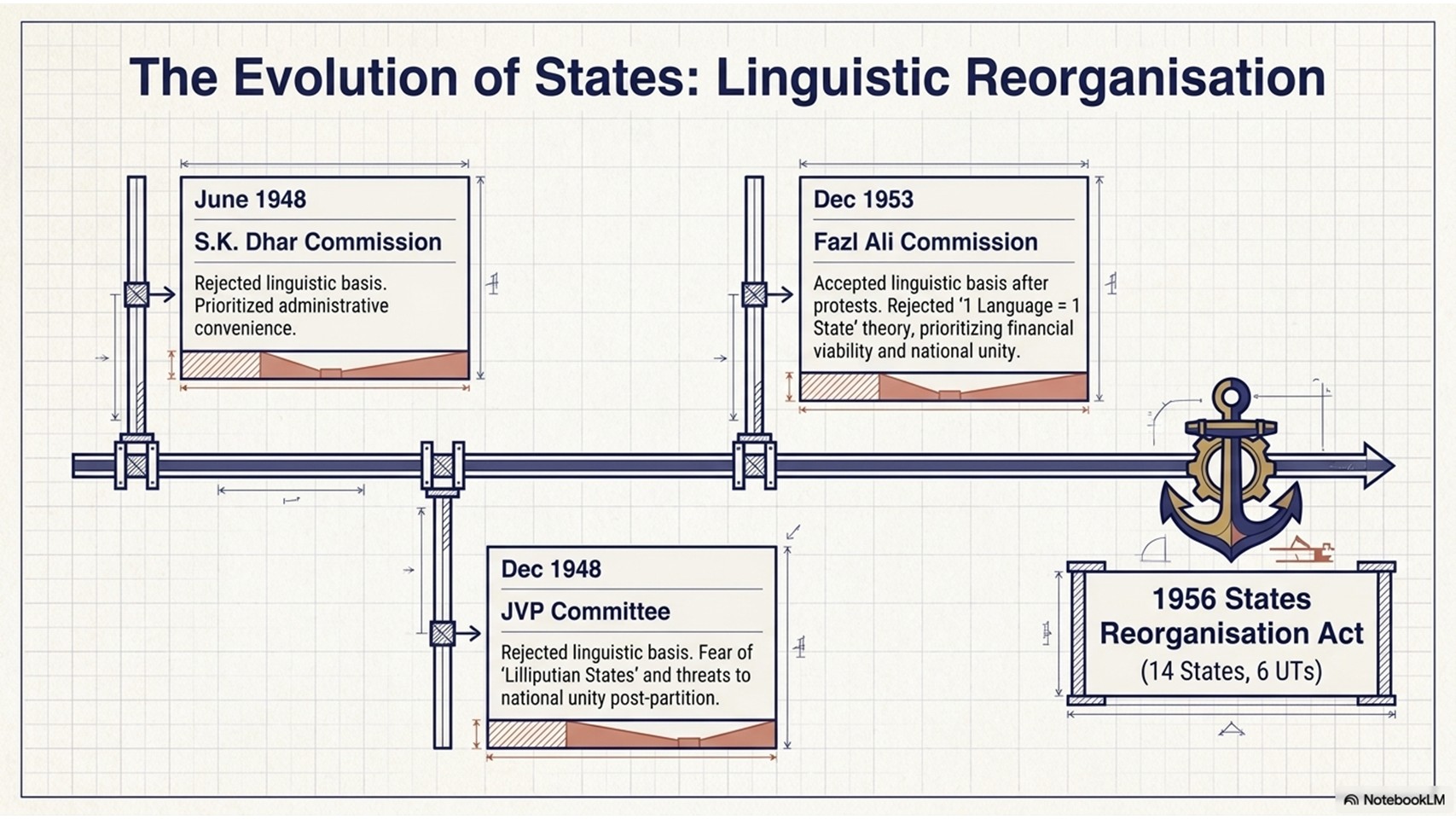
Committees can advise, but the government is not bound by their recommendations.
| Commission / Committee | Date | Stance on Linguistic Reorganisation |
|---|---|---|
| S.K. Dhar Commission (Linguistic Provinces Commission) |
June 1948 | Rejected linguistic reorganisation; recommended administrative convenience instead. |
| JVP Committee (Jawaharlal Nehru, Vallabhbhai Patel, Pattabhi Sitaramayya) |
Dec 1948 | Rejected linguistic reorganisation as it could jeopardize national security. |
Fazl Ali Commission (December 1953)
- Members: Fazl Ali (Chairman), K.M. Panikkar, H.N. Kunzru.
- Accepted linguistic reorganisation as a major basis but rejected the theory of 'One Language = One State'.
- Recommended that linguistic basis should not be used if it threatens or harms the unity and security of the country.
- Economic, administrative, and financial viability must be core parameters.
The Government of India passed the States Reorganisation Act in 1956 (7th CAA), modifying the recommendations to create 14 States and 6 Union Territories.
States & UTs in 1956 (After SRC 1956):
- 14 States: Andhra Pradesh, Assam, Bihar, Bombay, J&K, Kerala (merged Travancore-Cochin + Malabar), Madhya Pradesh, Madras, Mysore, Orissa, Punjab, Rajasthan, Uttar Pradesh, West Bengal.
- 6 UTs: Andaman & Nicobar, Delhi, Himachal Pradesh, Laccadive/Minicoy/Amindivi, Manipur, Tripura.
- Note: Himachal Pradesh, Manipur, and Tripura were UTs before gaining full statehood. Nagaland and Meghalaya were NEVER Union Territories.
Evolution of States & UTs (Post 1956)
| Year | Creation / Change |
|---|---|
| 1960 | Gujarat (15th State) and Maharashtra carved out of Bombay state. |
| 1961 (10th CAA) | Dadra and Nagar Haveli incorporated as a UT. |
| 1962 (12th & 14th CAA) | 12th CAA: Goa, Daman, and Diu added as UT. 14th CAA: Puducherry added as UT (merging French territories of Puducherry, Karaikal, Mahe, Yanam). |
| 1963 | Nagaland (16th State) carved out of Assam. |
| 1966 | Haryana (17th State) carved out of Punjab. |
| 1971 & 1972 | Himachal Pradesh (18th State) in 1971. Manipur, Tripura, and Meghalaya created in 1972. |
| 1974 & 1975 | Sikkim: 35th CAA (1974) made it an "Associate State". 36th CAA (1975) made it the 22nd State of India. |
| 1987 | Mizoram, Arunachal Pradesh, and Goa gained statehood. |
| 2000 | Uttarakhand (from UP), Chhattisgarh (from MP), and Jharkhand (from Bihar) created. |
| 2014 | Telangana created from Andhra Pradesh. |
Government Response to Reorganisation Demands
When demands for new states arise, the government uses several mechanisms to address them without resorting to state division immediately:
- Development packages and financial grants for regional development.
- Autonomous Councils for democratic rights demands (e.g., Darjeeling Gorkhaland Territorial Administration).
- Awarding 8th Schedule status to regional languages to protect local identity.
- Development Boards to address claims of uneven development within a state (e.g., Vidarbha Development Board under Article 371).
- Autonomous State status within an existing state (e.g., Meghalaya was initially created as an autonomous state within Assam via Article 244A).
Q Provide arguments in favor of and against smaller states in India. OR: "India does not just need smaller states, but more empowered states. Smaller states without greater economic & constitutional empowerment amount to nothing." Discuss.
The size of states has been heavily debated since independence. While Dr. B.R. Ambedkar believed India needed smaller states to ensure administrative efficiency, others feared it would break national unity.
Arguments IN FAVOR of Smaller States:
- Democratic Governance: Compact entities ensure policymakers have better awareness of local needs.
- Optimum Management: Linguistic compatibility and cultural homogeneity allow for better allocation and implementation of public resources.
- Articulate Communication: Homogeneous groups communicate easily, allowing marginal groups to raise their voices.
- Greater Accountability: Better representation of electorate preferences and higher accountability of elected representatives.
- Focused Administration: Regional aspirations are satisfied, ending the neglect or exploitation of specific regions.
- Development Success: The development trajectories of recently formed smaller states like Uttarakhand, Chhattisgarh, and Jharkhand indicate improvements.
3. Arguments Regarding Smaller States
- Financial Dependency: Many small states are not financially sustainable and remain dependent on the Centre for aid (e.g., North Eastern states).
- Political Opportunism: New states are often formed based on political expediency rather than objective evaluation (e.g., Telangana, Jharkhand).
- Political Instability: Smaller assemblies are vulnerable to defections affecting governance stability (e.g., Uttarakhand).
- Rise in Vulnerability: Fosters aggressive regionalism ("son of the soil" theory) and makes states vulnerable to pressure from multinational corporations.
- Administrative Friction: Leads to increased administrative overhead costs and multiple inter-state conflicts (like water sharing).
- Federal Imbalance: Reduces the bargaining power of states relative to the Centre in the federal setup.
Conclusion: The federal polity of India must accommodate the ongoing demands for smaller states democratically. Negotiating such demands might require the Centre to constitute a 2nd State Re-organisation Commission to evaluate demands objectively.