THE CONSTITUTION OF INDIA
PREAMBLE
WE, THE PEOPLE OF INDIA, having solemnly resolved to constitute India into a SOVEREIGN, SOCIALIST, SECULAR, DEMOCRATIC REPUBLIC and to secure to all its citizens:
JUSTICE social, economic and political;
LIBERTY of thought, expression, belief, faith and worship;
EQUALITY of status and of opportunity; and to promote among them
all;
FRATERNITY assuring the dignity of the individual and the unity and
integrity of the Nation;
IN OUR CONSTITUENT ASSEMBLY this twenty-sixth day of November, 1949, do HEREBY ADOPT, ENACT AND GIVE TO OURSELVES THIS CONSTITUTION.
1. Introduction to our Constitution
The Preamble is an introduction to our Constitution—a key to open the mind of the makers of the
Constitution.
The Preamble is the identity card of the Constitution (according to N.A. Palkhivala).
It is also referred to as the 'Horoscope' of our Sovereign, Democratic Republic (according to K.M.
Munshi).
The Preamble is referred to as the "Horoscope" because it comprises:
- Name of the nation
- Date of adoption/birth (D-O-B)
- Future vision and goals
- Soul/essence of the Constitution
Since the Preamble comprises all these elements, K.M. Munshi referred to it as the 'Horoscope'.
The Preamble is non-enforceable (non-justiciable) under the provisions of the Constitution, similar to Part IV (DPSPs). An enforceable provision means a constitutional rule contained in a specific Article that can be directly challenged in a court of law.
2. Concept of Popular Sovereignty
A social contract between two or more parties which lists rights, promises, and duties to prevent anarchy (lawlessness) and results in the formation of a State (Authority).
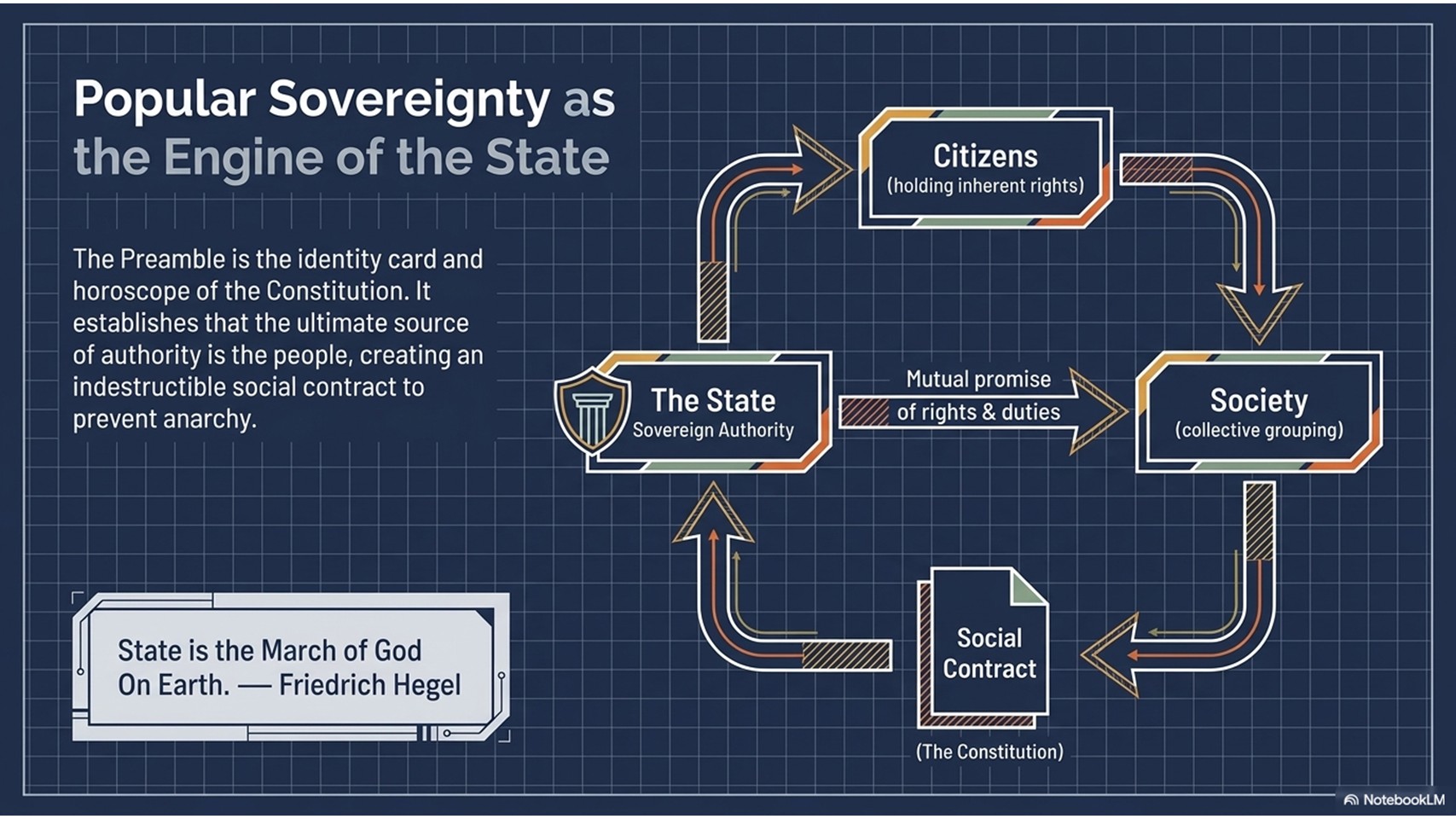
- Citizens → Society → Social Contract ← State
- Both parties promise rights/duties → Result → Sovereign State (Authority)
This contract is sacred, meaning you cannot easily tear it or withdraw from it. Why does the Preamble start with "WE, THE PEOPLE OF INDIA"? It indicates the concept of Popular Sovereignty.
3. Global Context
USA: The American Constitution was the first to begin with a Preamble. Many countries, including India, followed this practice.
China: The Chinese Constitution also includes a Preamble, starting from its first constitution in 1954 under Mao Zedong, through to the 1982 Constitution established during Deng Xiaoping's era.
India: In India, the right to free expression is vital, but as prominent jurists note: "While we have freedom of speech, what really matters is freedom after speech" (freedom from subsequent reprisal).
4. WE, THE PEOPLE & Sovereignty
What does "We, the People" signify? It signifies that the people of India are sovereign. It indicates the concept of popular sovereignty—that the ultimate source of authority for the Constitution is the people of India.
What does Sovereignty mean? It means having an independent authority to govern itself. There are two types of sovereignty: External and Internal.
What is external sovereignty? It means India is not subject to any foreign power or external control.
What is internal sovereignty? It means that within its territory, the State is supreme and free from any alien control. India is free to pursue any policy that it deems fit for the welfare of the people, whether in the social, economic, or political arena.
What is our stance on issues? India is free from any kind of external interference from other powers (like China, Russia, USA, etc.).
Some recent examples of sovereignty in practice:
- Continuously purchasing oil from Russia amid the Russia-Ukraine war, despite external pressure.
- Providing agricultural subsidies to farmers despite WTO limits. The WTO (World Trade Organization) is still contesting this in one way or another.
"State is the March of God On Earth"
— Friedrich Hegel
5. SOCIALIST
Q What does "Socialist" signify in India?
In India, it signifies that the welfare of the larger community supersedes that of an individual. It means establishing a degree of equity in society.
Q What is the difference between Socialism & Capitalism?
Capitalism focuses on profit motive and individual ownership of the means of production. In Socialism, the workers/laborers/working class are provided with much more power than the individual capitalist.
Q When was the word "Socialist" added to the Preamble?
It was not part of the original Preamble. It was added by Indira Gandhi via the 42nd Amendment Act of 1976. Even before that, our Constitution had socialist content in Part IV (DPSPs).
What does being a Socialist signify? It signifies the vision & direction of the Constitution to establish a "socialist pattern of society." In this framework, key sectors of the economy (Banks, Industries, etc.) will not be driven solely by profit motive but by service motive. India follows Democratic Socialism (mixed economy) rather than State Socialism (communism), blending Gandhian statelessness with Marxist classless ideals. (Note: This shifted significantly with the 1991 LPG reforms—Liberalisation, Privatisation, and Globalisation).
6. SECULAR
This word was not in the original Preamble. It was added to the Preamble by the 42nd Amendment Act of
1976 under the Indira Gandhi government.
Laïcité ← French form of strict secularism.
"An eye for an eye will make the whole world blind." (Famous quote by Mahatma Gandhi).
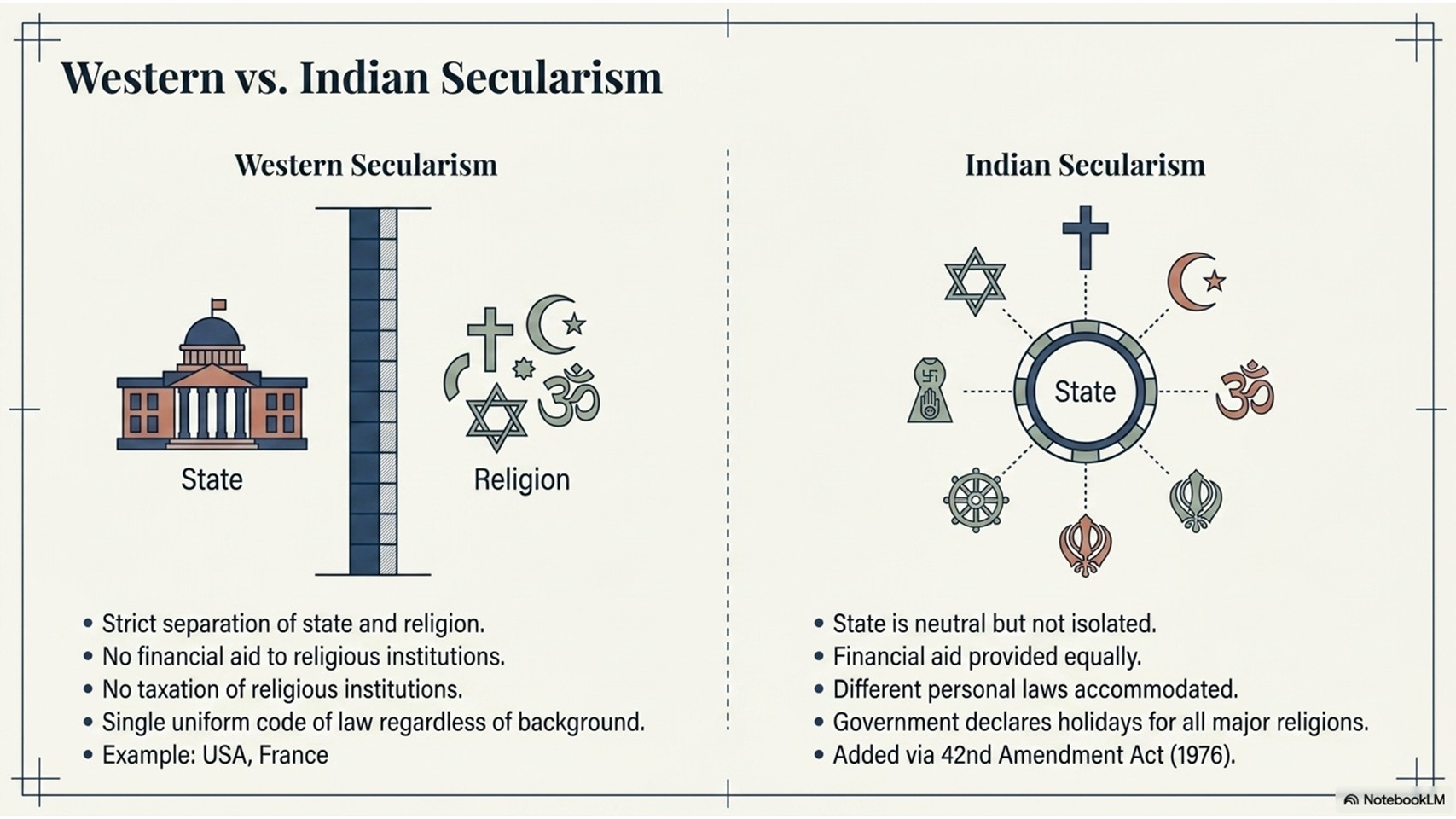
What is the meaning of Secularism? In its original terms (Western model), it signifies a strict separation of religion from the political, economic, and cultural aspects of life. For the West, religion is purely a personal/private sphere. (Note: The official name of India is the "Republic of India"—it has no state religion, unlike the "Islamic Republic of Pakistan").
What is the Indian form of secularism? The Indian model is a more positive form of secularism. In India, we do not have an official state religion, but all persons are equally entitled to freedom of conscience and the right to freely profess, practice, and propagate any religion they believe in.
Q. What is the difference between Western and Indian Secularism? Secularism is the principle that the state should not be dominated by any religion and should treat all religions fairly. However, secularism is understood and practiced differently in different countries. The two major models, Western Secularism and Indian Secularism, differ in their approach to state-religion relations.
| Western Secularism | Indian Secularism |
|---|---|
| In the West, the state is strictly separate from the functioning of all institutions & religious groups. | Secularism in India means that the state is neutral to all religious groups, but not completely isolated. In India, all expressions of religion are manifested equally with support from the State. |
| It does not believe in an open display of religion except for places of worship. | There is no clear, absolute distinction between state & religion in India. |
| The distinction between State & religion is clear & set in stone. | The state gives financial aid to religious institutions and taxes them as well. |
| The state treats all religions with equal indifference. It does not aid any religious institution through financial means or tax them. | Although the law is the same for all citizens, certain personal laws with regards to marriage and property rights are different for every community, but all are given equal consideration under the law. |
| A single uniform code of law is used to dispense justice regardless of religious background. | Ex: Govt declares holidays for all major religions (Diwali, Eid). Abolition of Untouchability (Article 17). |
| Ex - France: Public schools & gov offices do not allow religious
symbols. USA: Govt does not promote any religion (the "Wall of Separation" between Church & State). |
(Positive accommodation and equal support style of secularism) |
Conclusion: Both Western & Indian Secularism aim to ensure equality among citizens, but they differ in their method. Western secularism focuses on separation, while Indian secularism promotes harmony by respecting all religions equally.
7. DEMOCRATIC
Q How do you define Democracy?
Democracy has two dimensions: Procedural (electoral) and Substantive. Substantive means the protection of the rights of the people, right to associate, right to assemble, freedom of speech, etc.
Q How is India's performance as a democratic nation?
As far as procedural democracy (periodic elections) is concerned, democracy has been successful. But as a substantive democracy, India has grossly underperformed.
Q Is this what the Preamble envisaged?
Democracy in the Preamble was envisaged as not merely procedural but also substantive—meaning freedom of expression, basic rights of liberty, and freedom of speech are actively upheld by the government.
Q What are the types of Democracy?
                    graph TD
                        A[Democracy] --> B[Direct]
                        A --> C[Indirect / Representative]
                        B --> D[Referendum]
                        B --> E[Initiative]
                        B --> F[Recall]
                        B --> G[Plebiscite]
                        C --> H[E.g., India]
                        B --> I[E.g., Switzerland]
1. Direct Democracy: People exercise their supreme power directly. Example: Switzerland. Four devices of direct democracy are:
- Referendum: Binding vote to approve/reject specific legislation.
- Initiative: People themselves propose a bill.
- Recall: Voters remove a representative before term expiry.
- Plebiscite: Advisory, non-binding vote to gauge public opinion (e.g., Junagadh).
8. REPUBLIC
Q What does "Republic" signify?
It means that the Head of the State is elected (the President) and not nominated or
hereditary. The President is elected only by representatives who are themselves elected by the
people.
L.S (MP) + R.S + MLAs of every state vote weightage.
Q Must a democracy always be a Republic?
No. Britain is a democratic country but is not a Republic, as their Head of State is hereditary (monarch).
Q What other connotations are attached to a Republic?
A Republic also means that all public offices are open to all citizens without any discrimination, and that the political sovereignty rests with the people, not a single individual.
9. JUSTICE
Q What does "Justice" signify in the Preamble?
The term Justice can be understood in three distinct forms:
- Social Justice: Equal treatment of all citizens without any social distinction based on caste, color, race, religion, sex, etc. It also means the absence of privileges and the improvement in conditions of backward classes.
- Economic Justice: No discrimination based on economic wealth & income, and the
elimination of economic inequalities.
Social Justice + Economic Justice = Distributive Justice. - Political Justice: Equal political rights for all citizens, including equal access to political offices and an equal voice in government.
This aspect of Justice is described as distributive.
10. LIBERTY
Liberty can never be absolute and always comes with an "If" (Restrictions) → Reasonable Restrictions.
Q What does Liberty signify?
Liberty generally means the absence of restraints on the activities of individuals, but it always comes with a set of reasonable restrictions. It focuses on providing opportunities for individual development, but not at the cost of hurting another person's liberty.
Q How is Liberty signified in the Preamble?
Our Preamble ensures the liberty of thought, expression, belief, faith & worship. This is essential for a healthy deliberative democracy.
11. EQUALITY
Q What does Equality signify?
It signifies the absence of special privileges to any section of society, and the
provision of adequate opportunities for all individuals without discrimination.
(Note: Equality is not naturally occurring; it must be constructed by society/law.)
Q What does Equality in the Preamble signify?
Equality is conceived in India not merely in a formal/legal sense (equality before law), but also in a substantive sense as equality of opportunity.
Two dimensions of Equality:
1. Civic Equality: Guaranteed by Fundamental Rights (Articles 14 to 18).
2. Political Equality: Guaranteed by provisions like Article 325 (no person ineligible for electoral rolls based on religion, race, caste, sex) and Article 326 (Universal Adult Suffrage).
12. FRATERNITY
It means Brotherhood. It has both territorial as well as psychological dimensions.
Q What does Fraternity in India signify?
Fraternity is not confined merely to the boundaries of India. The idea of Fraternity is preferred to transcend India's borders to reach the ideals of Universal Brotherhood.
Q What does the Preamble say about Fraternity?
The Preamble declares to assure the Fraternity, Dignity of the Individual & the Unity and integrity of the Nation. If the dignity of the individual/citizen is not respected, they will not feel a sense of belonging or identity with the community at large; therefore, universal brotherhood will not be realized.
13. Is Preamble Part of Constitution?
The question first arose in 1960 in the Berubari Union case. Although the Preamble helps in interpreting the Constitution, the Court said that the Preamble is not a part of the Constitution (it is merely a preface).
However, in the 1973 Kesavananda Bharati case, the Supreme Court ruled that the Preamble is a part of the Constitution. The Court opined that the Constitution should be read and interpreted in the light of the grand and noble vision of the Preamble.
- The Preamble is neither a source of power to the legislature nor a limitation on its powers.
- It is non-justiciable & non-enforceable in nature (provisions cannot be enforced in courts of law).
14. Can the Preamble be Amended?
In the Berubari Union Case (1960), the Supreme Court said that the Preamble is not a part of the Constitution. Hence, it could not be amended under Article 368.
In the landmark Kesavananda Bharati case (1973), the Supreme Court overruled its earlier decision (Berubari Union case) and asserted that the Preamble is indeed a part of the Constitution. It can be amended under Article 368, but subject to the condition that no amendment is done to its Basic Structure.
In the LIC of India case (1995), the Supreme Court again upheld that the Preamble is an integral part of the Constitution.
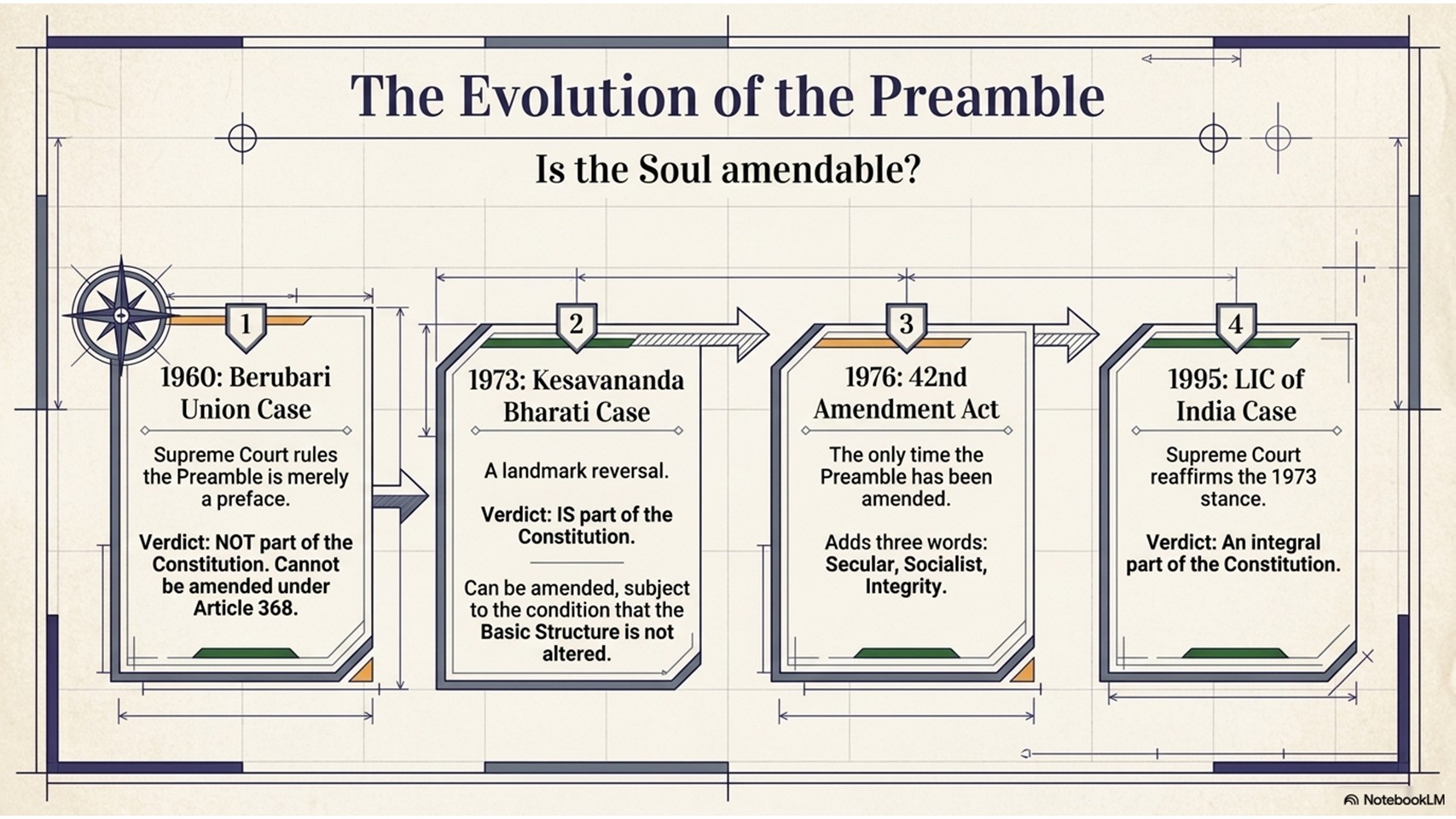
| Case Name | Ruling on Preamble |
|---|---|
| Berubari Union Case (1960) | Not part of the Constitution. Cannot be amended. |
| Kesavananda Bharati Case (1973) | Part of the Constitution. Can be amended (subject to the Basic Structure doctrine). |
| LIC of India Case (1995) | An integral part of the Constitution. Reaffirmed. |
Q How many times was the Preamble amended?
The Preamble was amended just once in 1976 via the 42nd Amendment Act.
Q How many words were added via the 42nd Amendment?
The 42nd Amendment added 3 words to the Preamble: Secular, Socialist, and Integrity.
Significance of the Preamble
- Serves as an important guide & GUIDING LIGHT to interpret the true spirit of the Constitution.
- Helps in determining the constitutional validity of a legislative or executive action.
- According to KM Munshi, the Preamble is the "Horoscope of our Sovereign, Democratic Republic."
- According to Pandit Thakur Das Bhargav, the Preamble is the "most precious part of the Constitution". It is the soul of the Constitution, a key to it, a jewel set in it, and a proper yardstick with which one can measure the worth of our Constitution.
- Sir Ernest Barker described the Preamble as the "Key-Note to the Constitution."
- Former CJI of India M. Hidayatullah observed that the Preamble resembles the Declaration of Independence of the USA, but is more than a declaration. It is the soul of our Constitution which lays down the pattern of our political society. It contains a solemn resolve which nothing but a revolution can alter.
Q What was the issue regarding the amendability of the Preamble?
Article 368 describes the procedure for amendment of the Constitution. Since the Preamble is a part of the Constitution but not a specific numbered provision (article) of it, there was doubt whether the power of amendment under Article 368 applied to it.
Q How was this resolved in the Kesavananda Bharati case?
In the 1973 Kesavananda Bharati case, the Supreme Court held that the Preamble can be amended under Article 368, subject to the condition that no amendment is done to its Basic Structure.
Therefore, while the Preamble can be amended, the basic elements or fundamental features of the Constitution outlined in it cannot be altered.
Q Is a Preamble necessary for every Constitution?
No, it is not necessary. For instance, the Government of India Act 1935 (which served as the Constitution of British India) did not contain a Preamble. However, in the modern era of representative and written systems of government, it has become customary for written constitutions to open with a Preamble.
Q Is the Preamble enforceable in India?
In India, the Preamble is not directly enforceable in a court of law. This means that while the Preamble outlines the fundamental purpose and guiding principles of the Constitution, it does not confer specific legal rights or obligations that can be enforced by the courts.