PART-II: CITIZENSHIP
Limitations of Part II:
Part II of the Constitution does not contain a permanent or detailed code regarding citizenship. It only identifies persons who became citizens of India at its commencement (Jan 26, 1950). It does not deal with the acquisition or loss of citizenship after this date. This is why Parliament enacted the Citizenship Act, 1955 using its powers under Article 11.
Note: In India, both citizens by birth and naturalized citizens are eligible for the office of President. (Contrast: In the USA, only birth citizens can become President).
1. Fundamental Concepts & Terminology
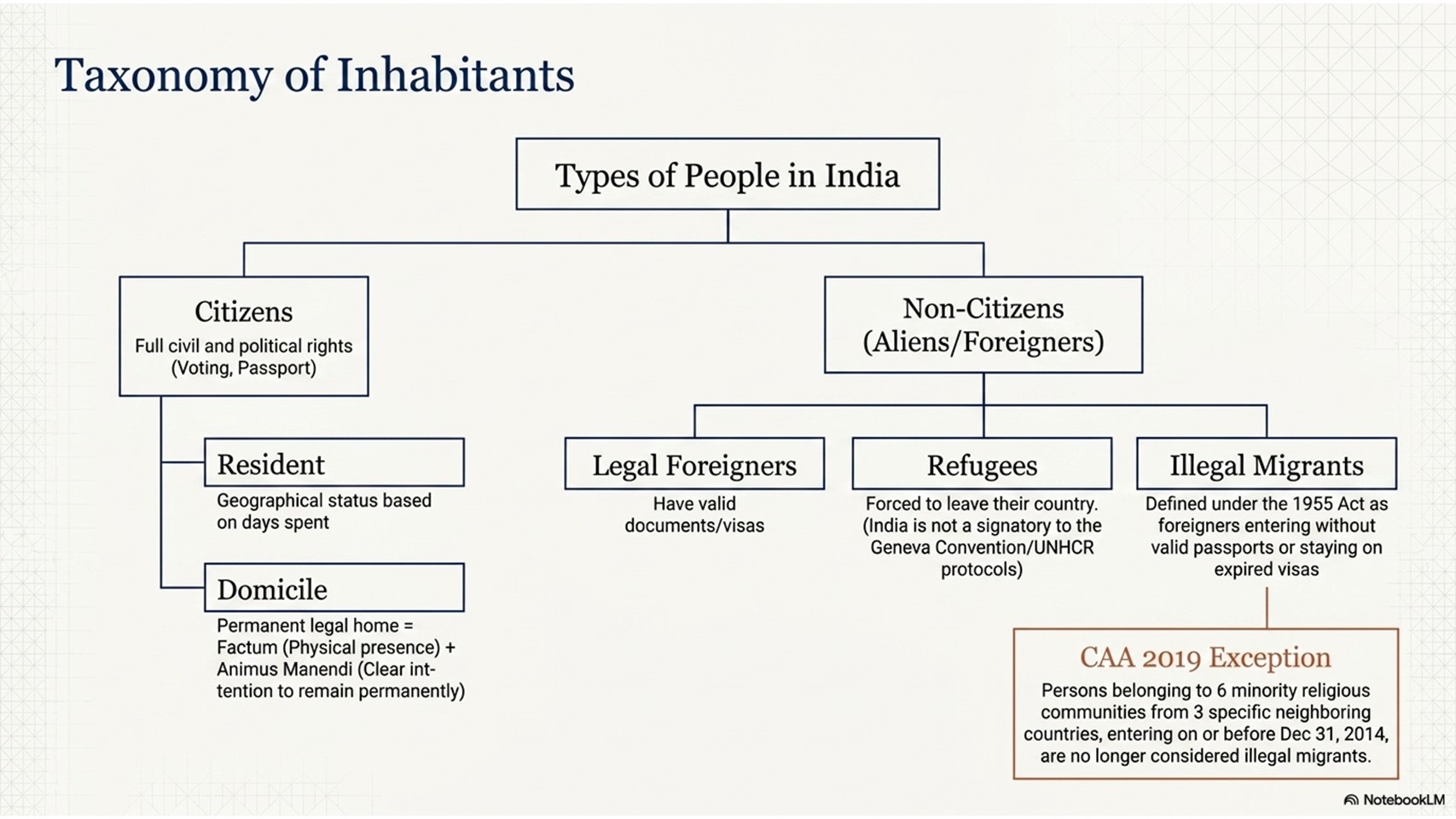
Understanding citizenship requires distinguishing between several key legal, physical, and geographical status terms:
Q1 What is Citizenship?
It is a legal and political status representing a solemn bond between the State and an individual. It grants full civil and political rights (e.g., voting, holding public office) and demands corresponding duties (e.g., paying taxes, defending the nation).
Q2 What is a Resident?
It is a physical and geographical status. It is a mathematical
concept based strictly on how many days a person physically spends within the geographical borders
of India during a financial year.
Example: An NRI residing in London who visits India for 185 days in a financial year is
classified as a Resident for tax purposes, yet retains their Indian citizenship.
Q3 What is Domicile?
It is an economic and welfare concept defining a person's permanent legal home, distinct from mere temporary physical presence. Domicile requires two concurrent elements:
- Factum: The physical presence of a person in a particular place.
- Animus Manendi: The clear, fixed intention to reside there permanently or indefinitely.
Example: An Indian student moving to the UK for a 3-year university degree has physical presence (Factum) in London, but lacks the intention to settle permanently (Animus Manendi). Thus, their domicile remains India.
Core Terminology List
- Immigration: The act of entering and relocating to live permanently in a foreign country.
- Emigration: The act of leaving one's own country to settle permanently elsewhere.
- Friendly Aliens: Citizens of foreign countries with which India maintains cordial diplomatic relations. They enjoy civil liberties but not political rights.
- Enemy Aliens: Citizens of a country currently at war with India. Under Article 22, they enjoy less protection and can be arrested or detained without standard protections.
Classification of Individuals
| Category | Characteristics & Rights |
|---|---|
| Citizens | Hold full political and civil rights (e.g., Voting rights, Indian Passport, eligibility for public office). |
| Residents | Individuals physically living in India (purely calendar-day based). |
| Non-Resident Indians (NRI) | Indian citizens holding Indian passports who live abroad for employment, education, or business. |
| Foreigners / Aliens (Legal) | Non-citizens residing in India with valid documentation (Visa/Passport). |
Refugees vs. Illegal Migrants
| Refugee | Illegal Migrant |
|---|---|
| Lacks valid documentation but was forced to flee their home country due to a well-founded fear of persecution. | Enters India without valid travel documents OR enters legally but overstays their visa duration. |
| Protected internationally by the UNHCR (UN High Commissioner for Refugees). | Dealt with strictly under domestic penal and citizenship laws. |
| 1951 Geneva Convention: Sets international rules. Note: India has NOT signed the 1951 Convention or the 1967 Protocol, handling refugees administratively instead. | Subject to detention and deportation under the Foreigners Act, 1946 and the Passport (Entry into India) Act, 1920. |
Info Why won't India sign the 1951 UN Refugee Convention?
India has not signed the 1951 Convention or its 1967 Protocol primarily for security reasons. South Asian borders are highly porous, and conflicts can trigger mass influxes. Additionally, India already hosts diverse refugee groups (Chakmas, Tibetans, Rohingyas) administratively without international mandates, following the ethos of Vasudhaiva Kutumbakam.
India's deportation of Rohingya refugees has sparked debate over international and domestic law.
- Non-Refoulement: A customary international law principle preventing states from deporting refugees to places where their lives are threatened. Though not a signatory to the 1951 Convention, some argue this customary norm still binds India.
- Constitutional Protection: Article 21 (Right to Life) and Article 14 (Right to Equality) apply to persons, not just citizens. Supreme Court precedents state the government cannot arbitrarily deprive any human being of life or liberty.
- Government Stance: India lacks specific refugee legislation, relying on the Foreigners Act, 1946, which grants the Centre unbridled power to deport foreign citizens.
Central Adverse List & Detention Centres:
- Central Adverse List: Maintained by the MHA. It blocks entry visas for individuals who supported the Khalistan movement, have terrorist links, or committed serious crimes abroad, preventing them from escaping prosecution.
- Foreigner Detention Centres: Temporary detention homes for foreign nationals staying illegally until deportation. Powers to deport are entrusted to state governments under Article 258(1).
Because India lacks a specific refugee law, the state relies on a patchwork of historical acts:
- Foreigners Act, 1946 (Section 3): Empowers the Central Government to detect, detain, and deport illegal foreign nationals.
- Passport (Entry into India) Act, 1920 (Section 5): Allows authorities to forcibly remove an illegal foreigner under Article 258(1) of the Constitution.
- Registration of Foreigners Act, 1939: Mandates that all foreign nationals (excluding OCIs) visiting India on a long-term visa (>180 days) must register with a Registration Officer within 14 days of arrival.
Rights Exclusive to Indian Citizens
The Constitution confers certain rights and privileges on the citizens of India that are denied to aliens:
- Fundamental Rights exclusive to Citizens: Articles 15 (protection against discrimination), 16 (equality of opportunity in public employment), 19 (freedom of speech, assembly, movement, etc.), 29 and 30 (cultural and educational rights).
- Political Rights: The right to vote in elections to the Lok Sabha and State Legislative Assemblies, and the right to contest elections to Parliament and State Legislatures.
- Public Offices: Eligibility to hold high constitutional offices such as the President, Vice-President, Judges of the Supreme Court and High Courts, Governor of States, Attorney General, and Advocate General.
Q Does India have a Permanent Residency concept like the US Green Card?
Historically, only PIOs were given such permits. However, the government introduced a Permanent Residency Status (PRS) for foreign investors.
- Minimum investment of ₹10 Crores.
- Must create at least 20 jobs.
- Grants a 10-year multiple-entry visa that is easily renewable.
2. Constitutional Provisions (Part II: Articles 5 to 11)
Crucial Constitutional Facts:
- Undefined Term: The term "citizen" is actually never defined in the Constitution itself.
- Early Enforcement: Unlike the rest of the Constitution (which took effect on Jan 26, 1950), Articles 5 to 11 came into force on November 26, 1949.
- Guiding Principle: Indian citizenship laws prioritize Jus-sanguinis (right of blood/descent) over Jus-soli (right of the soil/birthplace).
These articles determined who became a citizen of India specifically on January 26, 1950. They are divided into categories:
Article 5: Citizenship by Domicile
A person became an Indian citizen at commencement if they had their domicile in India and met any ONE of the following conditions:
- They were born in the territory of India.
- Either of their parents was born in the territory of India.
- They had been ordinarily resident in India for not less than five years immediately preceding the commencement of the Constitution.
Example: A British academic who moved to India in 1944 with the clear intent to make India their home, and lived here continuously for 5 years, became a citizen under Article 5.
Article 6: Migrants from Pakistan to India
A person who migrated from Pakistan to India became a citizen if they, or either of their parents, or any of their grandparents, were born in undivided India, subject to a cut-off date of July 19, 1948 (when the permit system was introduced):
- Migrated BEFORE July 19, 1948: Deemed citizen if they resided in India ordinarily since the date of migration.
- Migrated ON or AFTER July 19, 1948: Must be registered as a citizen by an appointed officer. Requires residing in India for at least six months immediately before applying.
Example: A family fleeing Rawalpindi arriving in Delhi on June 10, 1948, became citizens automatically. Another arriving on September 5, 1948, had to register after waiting 6 months.
Article 7: Migrants from India to Pakistan
A person who migrated to Pakistan from India after March 1, 1947, ceased to be a citizen of India.
Exception: If they returned to India under a permanent resettlement or return permit issued under Indian law, they could apply for citizenship by registering after residing in India for at least 6 months.
Articles 8 to 11: General Constitutional Framework
| Article | Constitutional Provision Details | Practical Example / Context |
|---|---|---|
| Article 8 | A person of Indian origin residing outside undivided India becomes a citizen if registered by the diplomatic or consular representative of India in their country of residence. | An Indian merchant living and working in Singapore in 1950 could secure citizenship by registering at the local Indian consulate. |
| Article 9 | If a person voluntarily acquired the citizenship of any foreign state at or before the commencement of the Constitution, their right to Indian citizenship under Articles 5, 6, or 8 was instantly barred. | Dealt strictly with the 1950 snapshot. Modern day voluntary acquisition cases (e.g., an actor getting a Canadian passport today) trigger automatic termination under Section 9 of the Citizenship Act, 1955. |
| Article 10 | Every citizen shall continue to be a citizen, subject to the provisions of any law made by Parliament. | Prevents the government of the day from arbitrarily stripping citizens of their rights without parliamentary backing. |
| Article 11 | Explicitly grants Parliament the absolute power to regulate the acquisition, termination, and all other matters relating to citizenship. | This article is the legislative bridge that allowed Parliament to pass the comprehensive **Citizenship Act, 1955**. |
Rationale Behind Single Citizenship
Although the Indian Constitution is federal and establishes a dual polity (Union and States), it provides for only a **Single Citizenship**. Unlike the USA, where a person is a citizen of both the US and their specific state (e.g., Texas), an Indian citizen owes allegiance only to the Union of India. This is to foster national integration and prevent local discrimination.
- Article 16(3): Parliament enacted the Public Employment (Requirement as to Residence) Act, 1957, allowing residence requirements for non-Gazetted posts. While the original framework expired, residency-based employment safeguards operate via Article 371D for Andhra Pradesh and Telangana, and via Article 371J for the Hyderabad-Karnataka region.
- Article 15: States are prohibited from discriminating only on grounds of religion, race, caste, sex, or place of birth—not residence. States can grant educational fee concessions to their residents.
- Article 19: Free movement and residence can be restricted to protect Scheduled Tribes, safeguarding their culture, language, customs, property, and traditional vocations.
- Former Article 35A (Jammu & Kashmir): Allowed the J&K Legislature to define "permanent residents". Revoked completely in 2019 by 'The Constitution (Application to Jammu and Kashmir) Order, 2019'.
Objectives vs. Reality:
India's single citizenship principle is heavily inspired by the Canadian model and aims to promote unity, fraternity, and national integration.
However, despite this framework, India continues to face challenges such as communal riots, caste-based conflicts, class clashes, ethnic disputes, and linguistic tensions, leaving the vision of a fully integrated nation partially unfulfilled.
3. The Citizenship Act, 1955
This act governs all citizenship acquisition and termination after 1950. It has been amended 6 times (1986, 1992, 2003, 2005, 2015, and 2019).
Deciding Authority:
The authority to grant, reject, or revoke citizenship under the 1955 Act lies entirely with the Ministry of Home Affairs (MHA), representing the Central Government.
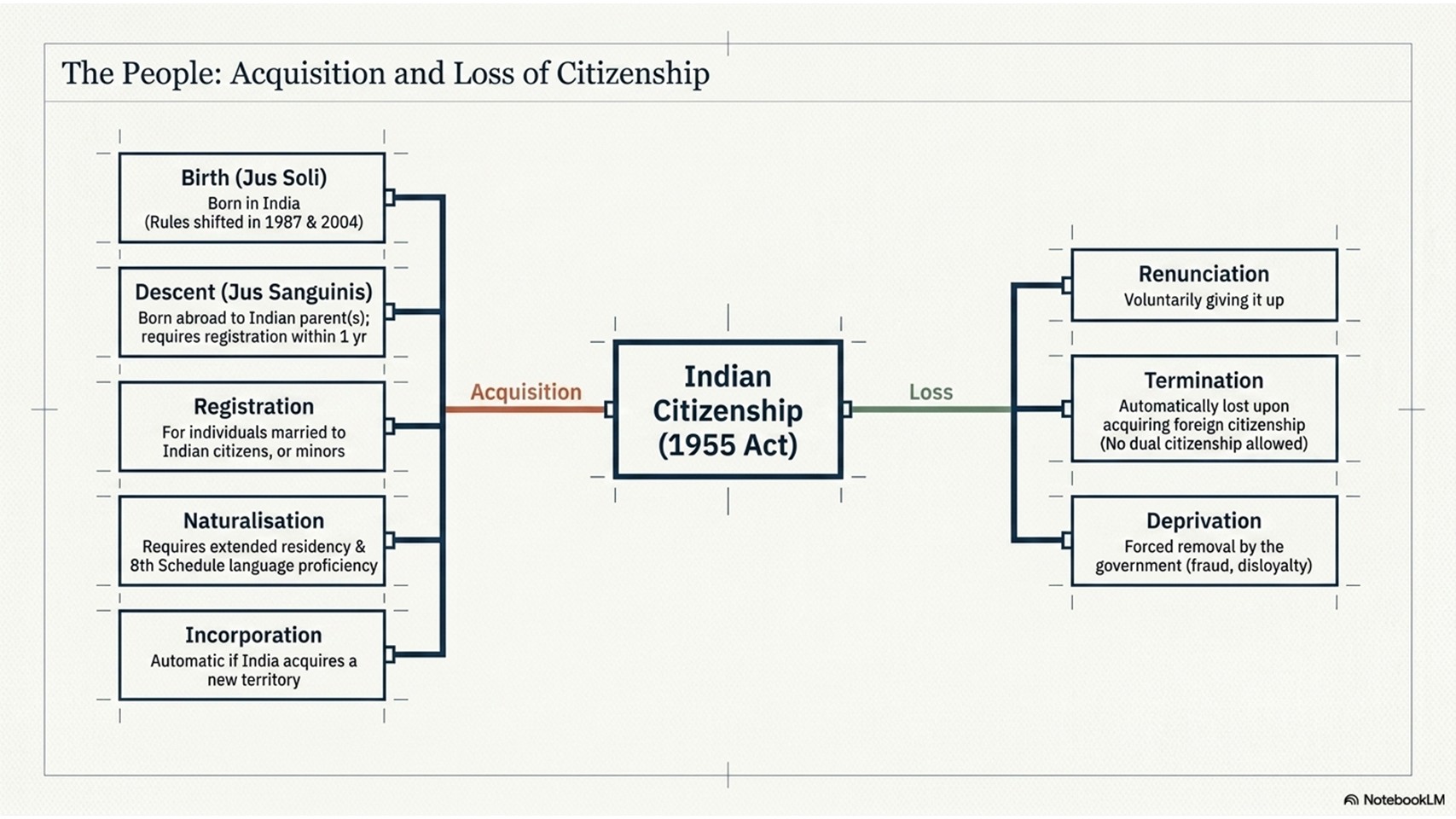
A. Acquisition of Citizenship (5 Ways - Mnemonic: BRAND)
- By Birth:
- Born between 26 Jan 1950 and 1 July 1987: Citizen by birth regardless of parents' nationality.
- Born between 1 July 1987 and 3 Dec 2004: Citizen if at least one parent was an Indian citizen at birth.
- Born on/after 3 Dec 2004: Citizen only if both parents are Indian citizens OR one parent is a citizen and the other is not an illegal migrant.
- Exception: Children of foreign diplomats and enemy aliens born in India cannot acquire citizenship by birth.
- By Registration:
The Central Government may register specific categories of people (who are not illegal migrants) upon application. All categories must take an Oath of Allegiance before registration.
- PIOs: Persons of Indian Origin ordinarily resident in India for 7 years, OR residing in any country outside undivided India.
- Marriage: Persons married to Indian citizens and ordinarily resident in India for 7 years.
- Minors & Dependents: Minor children of Indian citizens, or persons of full age whose parents are registered as citizens.
- Former Citizens: Persons of full age (or their parents) who were earlier citizens of independent India, resident for 12 months.
- OCI Route: A person registered as an Overseas Citizen of India (OCI) cardholder for 5 years, and ordinarily resident in India for 12 months before applying.
- By Acquisition of Territory:
- If a foreign territory becomes part of India, the Government specifies which residents of that territory become Indian citizens.
- Example: When Pondicherry became part of India in 1962, the Government issued the Citizenship (Pondicherry) Order, 1962.
- By Naturalisation:
- For foreign nationals with no lineage/marital ties to India. Requirements:
- Must renounce their foreign citizenship.
- Must have resided in India (or served the government) continuously for 12 months immediately preceding the application.
- Must have resided in India for at least 11 years out of the preceding 14 years.
- Must possess good character and adequate knowledge of a language specified in the 8th Schedule.
- Example: Adnan Sami, a Pakistani citizen, was granted Indian citizenship via naturalisation in 2016 after meeting the residency criteria.
Note: Every naturalised citizen must strictly take an Oath of Allegiance to the Constitution of India.
Naturalisation Waivers & Languages:
- Distinguished Service: The Government may waive all or any naturalisation conditions for individuals who have rendered distinguished service to science, philosophy, art, literature, world peace, or human progress.
- 8th Schedule Requirement: The applicant must have adequate knowledge of at least one of the 22 recognized languages: Assamese, Bengali, Bodo, Dogri, Gujarati, Hindi, Kannada, Kashmiri, Konkani, Maithili, Malayalam, Manipuri, Marathi, Nepali, Oriya, Punjabi, Sanskrit, Santhali, Sindhi, Tamil, Telugu, and Urdu.
- For foreign nationals with no lineage/marital ties to India. Requirements:
- By Descent:
- Born outside India between 26 Jan 1950 and 10 Dec 1992: Citizen if father was an Indian citizen at the time of birth.
- Born outside India between 10 Dec 1992 and 3 Dec 2004: Citizen if either parent was a citizen (introduced gender equality in descent rules).
- Born outside India on/after 3 Dec 2004: Not a citizen unless the birth is registered at an Indian consulate within one year of birth.
- Strict Conditions for Post-2004 Births: The registration application must include a written undertaking from the parents that the minor child does not hold a passport of another country.
- Attaining Majority: A minor who is a citizen by descent and also holds foreign citizenship will automatically lose Indian citizenship if they do not renounce their foreign nationality within 6 months of attaining full age (18 years).
B. Termination of Citizenship (3 Ways - Mnemonic: TDR)
- By Termination (Automatic):
- If an Indian citizen voluntarily acquires the citizenship of another country, their Indian citizenship is automatically terminated.
- Exception: This provision is suspended during a war in which India is actively engaged.
- By Deprivation (Government Action):
- Compulsory deprivation of citizenship by the Central Government on specific statutory
grounds under Section 10:
- If citizenship was obtained by fraud, false representation, or concealment of material facts.
- If the citizen has shown disloyalty to the Constitution of India.
- If the citizen has unlawfully traded or communicated with an enemy during a war.
- If, within 5 years of registration/naturalisation, the citizen is sentenced to imprisonment in any country for 2+ years.
- If the citizen has been ordinarily resident out of India continuously for 7 years without registration.
- Compulsory deprivation of citizenship by the Central Government on specific statutory
grounds under Section 10:
- By Renunciation (Voluntary):
- Any adult Indian citizen of sound mind can make a declaration renouncing their citizenship.
- Upon registration of this declaration, they cease to be an Indian citizen. Consequently, their minor children also lose Indian citizenship. However, such children can resume citizenship by making a declaration within one year of turning 18.
4. Modern Developments, Diaspora, & Special Acts
The Indian Diaspora: NRI, OCI, and PIO
The diaspora consists of people of Indian descent living abroad, categorized to manage their connection with their country of origin:
NRI Non-Resident Indian:
An Indian citizen holding a valid Indian passport who stays outside India for employment, education, or business for 183 or more days in a financial year. NRIs retain voting rights in India.
OCI Overseas Citizen of India:
A cardholder status for foreign nationals of Indian origin. Recommended by the L.M. Singhvi Committee (2002). In 2015, the PIO (Person of Indian Origin) category was discontinued and merged entirely into the OCI scheme.
Pravasi Bharatiya Divas:
Celebrated on January 9. This date commemorates January 9, 1915, when Mahatma Gandhi—the greatest Pravasi—returned to India from South Africa to lead the national movement.
Overseas Citizen of India (OCI) Evolution & Legal Framework
The OCI scheme was recommended by a High-Level Committee on the Indian Diaspora, chaired by L.M. Singhvi, set up in September 2000 (report submitted Jan 2002).
- Aug 19, 2002: PIO Card scheme introduced.
- 2003 CAA: Removed Commonwealth Citizenship and introduced the OCI scheme limited to PIOs of 16 specified countries.
- 2005 CAA (Dec 2, 2005): OCI card formally launched and eligibility expanded to all countries, except Pakistan and Bangladesh.
- 2015 CAA (Jan 9, 2015): The PIO scheme was officially rescinded due to confusion, and all PIO cardholders were deemed OCI cardholders.
OCI Eligibility, Benefits & Restrictions
| Eligibility & Benefits | Restrictions (Rights Denied to OCIs) |
|---|---|
| Eligibility: A foreign national who was a citizen of India at commencement, or child/grandchild/great-grandchild of such a person, or spouse of an Indian citizen (minimum 2 years of marriage). | Political Rights: No Right to Vote in Indian elections. No Right to contest in elections (cannot become MP, MLA, or President). |
| Travel Benefits: Lifelong multiple-entry, multi-purpose visa-free travel to India. Exempt from registering with local police/FRRO for any length of stay. | Public Office (Article 16): Cannot hold public employment, civil services, or constitutional posts without specific government exemption. |
| Parity: Parity with NRIs in economic, financial, and educational facilities (except purchasing agricultural or plantation land). | Executive & Judiciary (Articles 58, 66, 124, 217): Ineligible to hold the office of President, Vice President, or be appointed as a Judge of the Supreme Court/High Court. |
| Exclusion Clause: Anyone who has ever been a citizen of Pakistan or Bangladesh is strictly ineligible. |
Case Study: Aatish Taseer (2019)
- Background: British-born author raised in India by his mother, Tavleen Singh (an Indian journalist).
- Incident: In 2019, the Ministry of Home Affairs (MHA) revoked Taseer's OCI status, blacklisting him from entering India.
- Reasoning: OCI rules strictly forbid granting status to anyone whose parent or grandparent was a citizen of Pakistan. The MHA stated Taseer concealed the fact that his father (Salmaan Taseer) was a Pakistani citizen. This highlights the strict implementation of the Pakistan/Bangladesh exclusion clause.
Cancellation of OCI Registration (Including CAA 2019 additions):
The Government of India may cancel OCI registration on several grounds. Note: A reasonable opportunity of being heard must be given before cancellation (added via CAA 2019).
- Registration obtained by fraud, false representation, or concealment.
- Showing disaffection towards the Constitution or trading with the enemy during war.
- Sentenced to imprisonment for 2 years or more within 5 years of registration.
- Added via CAA 2019: Violating the Citizenship Act, 1955, or any other law notified by the GoI.
- Added via CAA 2019 (Marriage Grounds): If the marriage dissolves by court order, or if the marriage subsists but the foreign spouse has remarried someone else.
5. Citizenship Amendment Act (CAA) 2019
The CAA of 2019 amended the 1955 Act to provide a fast-track pathway for persecuted religious minorities from neighboring states.
- Must belong to one of the 6 minority religious communities: Hindus, Sikhs, Buddhists, Jains, Parsis, and Christians. (Excludes Muslims).
- Must have migrated from one of the 3 neighboring countries: Afghanistan, Pakistan, and Bangladesh.
- Must have entered India on or before December 31, 2014.
Furthermore, the Act reduces the naturalisation residence requirement from 11 years to 5 years for these eligible individuals.
Territorial Exemptions under CAA:
To protect tribal demographics, the provisions of the CAA 2019 do NOT apply to:
- Tribal areas of Assam, Meghalaya, Tripura, and Mizoram included in the **Sixth Schedule** of the Constitution.
- Areas covered under the **Inner Line Permit (ILP)** system (Arunachal Pradesh, Nagaland, Manipur, and Mizoram).
Mnemonic for ILP states: NagMani ArMi (Nagaland, Manipur, Arunachal, Mizoram).
Citizenship (Amendment) Rules, 2024:
Notified by the MHA to enforce the CAA 2019. Key updates include:
- Applications must be submitted in electronic form to an Empowered Committee through a District Level Committee.
- Applicants can provide up to 20 different documents (visas, census slips, Aadhaar, etc.) as proof of entry into India.
- Requires an affidavit verifying statements and another by an Indian citizen testifying to the applicant's character.
- Requires a declaration that the citizenship of their home country will be irrevocably renounced upon approval.
Critical Analysis of CAA 2019
| Arguments Against the Act | Arguments In Favour of the Act |
|---|---|
| Violates Secularism: Specifically targets Muslims, violating Article 14 (Right to Equality) and the secular fabric of the Constitution. | Theocratic Neighbours: Pakistan, Afghanistan, and Bangladesh are Islamic republics; hence, Muslims are the majority and technically cannot face state-sponsored religious persecution. |
| Excludes Other Refugees: Ignores other persecuted groups like Tamil refugees from Sri Lanka and Hindu Rohingyas from Myanmar. | Historical Responsibility: India conceded during Partition and the 1972 Indira-Mujib Pact that minorities in the neighbourhood are its responsibility. |
| Implementation Issues: Delineating between genuine persecuted minorities and illegal economic migrants is practically difficult. | Victims of Partition: Acts as a boon to people who have suffered due to the conversion of neighbouring states into theocratic republics. |
6. National Register of Citizens (NRC) & Assam Accord
The NRC is a list of all genuine Indian citizens. Currently, Assam is the only state in India that maintains an NRC, which was updated under the supervision of the Supreme Court to identify illegal immigration.
In the 1970s, Assam experienced massive illegal migration from East Pakistan/Bangladesh (approximately 1 crore migrants in 1971). The All Assam Students' Union (AASU) led a 6-year movement demanding deportation, culminating in the historic 1985 Assam Accord.
Section 6A is a special provision inserted in the 1955 Act following the Assam Accord. It set a unique timeline for citizenship in Assam:
- Before Jan 1, 1966: All persons of Indian origin entering Assam from Bangladesh are deemed citizens.
- Jan 1, 1966 to March 24, 1971: Migrants are granted citizenship, but their voting rights are suspended for 10 years from the date of detection as foreigners.
- After March 24, 1971: The strict cut-off date for identification and deportation of illegal migrants.
Note: In 2024, a Constitution Bench of the Supreme Court upheld the constitutional validity of Section 6A of the Citizenship Act.
The Fall of the IMDT Act, 1983:
Initially, foreigner identification in Assam was governed by the Illegal Migrants (Determination by Tribunal) Act, 1983. However, in 2005 (on a petition by Sarbananda Sonowal), the Supreme Court struck down the IMDT Act as unconstitutional.
Reasoning: The court ruled that applying a different, geographically-based classification solely to Assam violated the Right to Equality under Article 14.
Info Foreigners Tribunals & D-Voters
"D-Voters" (Doubtful Voters) are individuals disenfranchised by the Election Commission due to alleged lack of proper citizenship credentials. Their citizenship status is decided by Foreigners Tribunals set up under the Foreigners Act, 1946. Under Section 9 of the Foreigners Act, the burden of proving citizenship lies upon the individual applicant, not the government.
National Population Register (NPR) vs. Census vs. Aadhaar
The NPR is a database of all "usual residents" of the country (any person residing in a local area for at least 6 months, or intending to stay for the next 6 months). Prepared under the Citizenship Act 1955 and the 2003 Rules.
| Aspect | NPR (National Population Register) | AADHAAR (UIDAI) | Decennial Census |
|---|---|---|---|
| Registration | Strictly Compulsory for all residents. | Strictly Voluntary. | Compulsory (protected by strict confidentiality laws). |
| Data Collected | Demographic details + biometric verification. | Biometric details + minimal demographic data. | Aggregated macro demographic data (no individual documents required). |
| Legal Purpose | Identifies residential status; acts as the base list for NRIC (National Register of Indian Citizens) under Section 14A. | Serves solely as proof of identity and address for welfare distribution. Cannot prove citizenship. | Used for policy framing, delimitation of constituencies, and statistical data. |
7. Aadhaar: Identity, Data, & Audits
Aadhaar is a 12-digit identification number issued to residents of India by the UIDAI. NRIs are also eligible to obtain it.
- Statutory Body: UIDAI operates under the Ministry of Electronics and Information Technology (MeitY).
- RTI Applicability: UIDAI is not exempted from the RTI Act of 2005, though some security restrictions apply.
- Blue Aadhaar: A specific variant issued to children up to 5 years of age (no biometrics captured).
- Data Captured: Demographic (Name, DOB, Gender, Address) and Biometric (10 fingerprints, 2 iris scans, facial photograph).
| Where Aadhaar is REQUIRED | Where Aadhaar is NOT REQUIRED |
|---|---|
| Filing Income Tax Returns (ITR) | Opening a standard Bank Account |
| Linking with PAN Card (Mandatory) | Procuring a mobile SIM card |
| Targeted Delivery of Welfare Schemes (PDS, MGNREGA) | School Admissions & Registration of Births/Deaths |
2022 CAG Audit Report Findings:
The Comptroller and Auditor General found critical flaws in the Aadhaar issuance process:
- No Proof of Residency: The Aadhaar Act mandates that only 'Residents' (182 days in the last year) can be issued the ID.
- Flawed Verification: Aadhaar is often issued based on casual self-declarations by applicants, with no robust system to verify these claims.
5. Contemporary Citizenship Issues
Indian Origin Tamils (IOT) in Sri Lanka
Excluded from the CAA 2019, IOTs are descendants of indentured Tamil workers shipped by the British in the 19th century to work on Sri Lankan tea estates. They are historically distinct from Sri Lankan Tamils.
- 1948 Citizenship Act (Sri Lanka): Excluded IOTs to consolidate the Sinhalese political base, rendering hundreds of thousands stateless.
- This systemic alienation directly fueled ethnic violence and the civil war in the 1970s and 1980s.
Surrogacy & Citizenship Complications
Unregulated commercial cross-border surrogacy ("Rent a Womb") created massive legal voids regarding the nationality, parentage, and rights of the child.
Issue Statelessness in Surrogacy
If a foreign couple commissions a surrogate in India, the child may be denied the nationality of the parents' home country due to conflicting domestic laws, leaving the infant stateless. The lack of an international treaty (like the Hague Adoption Convention) for surrogacy exacerbates this crisis.
Key Administrative Bodies
| Organisation / Office | Role & Significance |
|---|---|
| Registrar General & Census Commissioner (RGI) | Functions under the MHA. Responsible for demographic surveys, the Census (Entry 69, 7th Schedule), and acting as the National Registration Authority for the NRIC. |
| International Organisation for Migration (IOM) | UN-affiliated intergovernmental body managing global migration. Fact: According to the Global Migration Report 2020, India is the largest country of origin for international migrants and the top remittance recipient. |